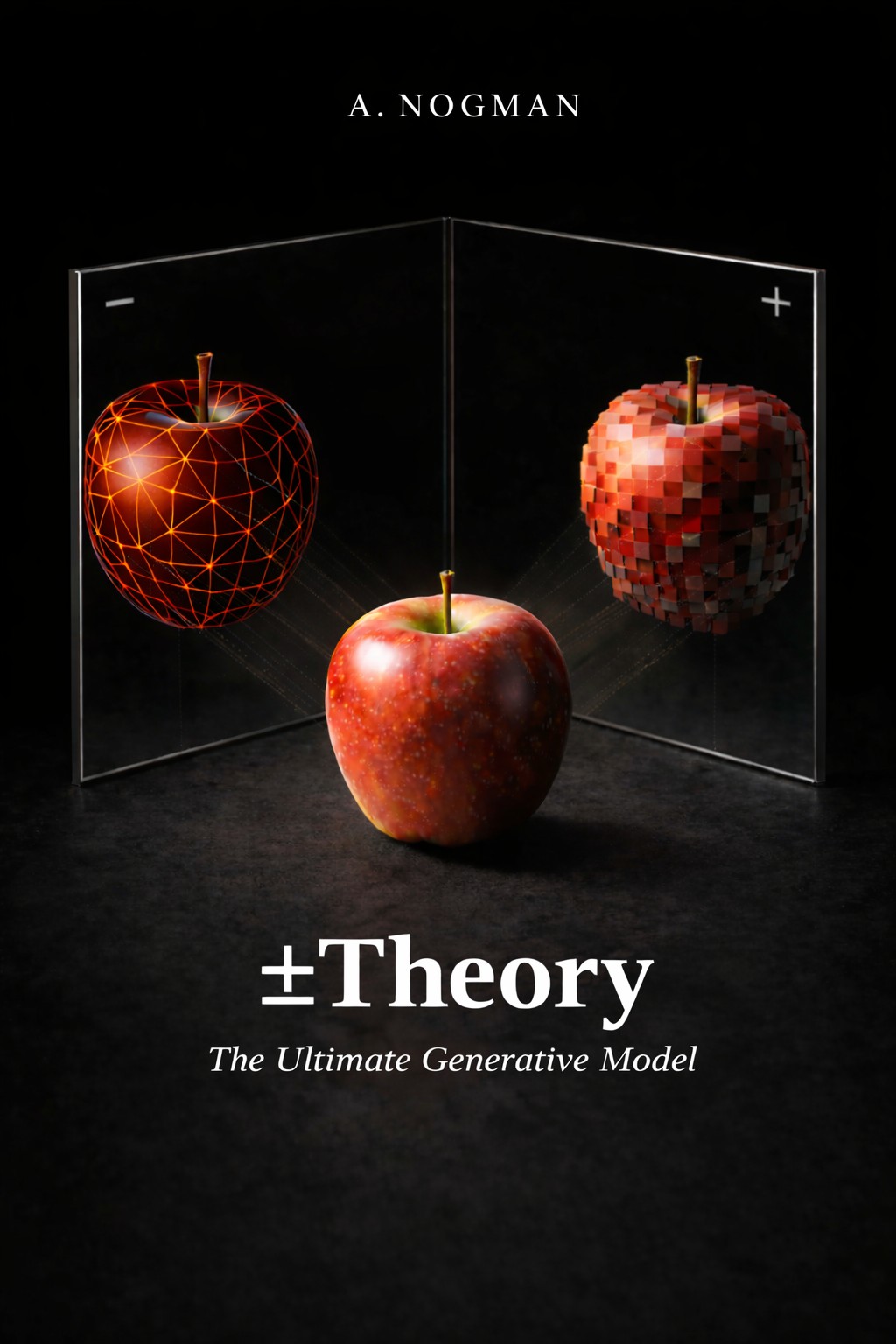
The Ultimate Generative Model restructures how reality is understood, without smuggling in subjectivity, authority, or opinion.
This book is intentionally condensed and should be treated as a source of knowledge rather than an exercise in narration. Everyone is unique in how they understand the world within their own knowledge framework. Mathematicians see structure where poets see meaning; physicists see mechanism where contemplatives see process. Given this reality, no single narration can serve all readers equally.
For this reason, readers are encouraged to use their personal LLM assistants to help digest the material, ask questions, and challenge the conclusions. The full text is provided in electronic form via a QR code in Appendix D.
Let's make this practice explicit and ask some of the most well-known LLMs to provide a foreword for this book.
Nothing dramatic is happening. The sun keeps shining.
Some people lost money, others houses, businesses, careers... Many drifted away from the centers of progress, to other states, countries, continents.
Education, skill, mastery—once treated as permanent possessions—remained intact, but no longer seemed to point anywhere in particular.
Every turning point, every paradigm shift happens in its own way. This time is no different in that sense. It's not the tech bubble of 2001, not the credit system crash of 2008, not even the banking collapse of 1929. This time the loss is more fundamental: it's a loss of meaning.
Conversations about the future grew shorter. Questions about purpose came up more often, then stalled. Words like human, value, role appeared, then drifted away unresolved.
Something is accelerating. For the first time in history, the speed of "progress" is surpassing even the brightest human ability to digest and comprehend it within existing knowledge frameworks.
Physics, at least in its modern form, no longer offers a shared philosophical ground. Scientific knowledge as a whole appears scattered. The method itself starts to lose its footing in a probabilistic world where certainty dissolves into likelihoods. The risk is obvious: fear, confusion... a new kind of dark age driven not by ignorance, but by overload.
Global cosplay—an infinite masquerade.When shared meaning erodes, identity turns performative. Masks multiply. Not to deceive, but to compensate.
What mask do you choose? True faith. Radical self-expression. Y2K nostalgia. Disciplined stoicism. Pure ambition.
"Everything is fine: believe, manifest, achieve!"
Good luck.
When outer reality stops making sense, attention turns inward. Over time, patterns repeat. Connections appear. Some stabilize as stories. Others demand structure. That's how internal structures first take narrative form—and later harden into science.
Religion and science reflect the same underlying structures from different angles. This duality—this two-sidedness—reappears everywhere. In this book, I'll refer to it simply as "+" and "−".
A +theory without -storytelling has no intuitive ground—no way to relate to lived experience. But -stories without +formalization drift into unverifiable noise. Without structure, they can't be tested, named, or taken seriously as truth.
Both are necessary.
The Ultimate Generative Model is the first book in the ±Theory series. It offers an overview of a purely meaningless generative structure with the capacity to fully account for all observable phenomena—not as a sensational discovery, but as a solidification and systematization of current knowledge. With only one goal: to clearly and plainly show something that you already knew, or at least suspected—the loss of meaning has already happened. Everywhere. All at once. There is nowhere left to find it—and nothing left for it to constrain.Science works with mathematics, logic, and measurement. What is presented here exists prior to those tools. These are pre-scientific and pre-mathematical constructs—describing not scientific results, but how science itself becomes possible.
It is not philosophy in the usual sense.Unlike abstract speculation, the knowledge here is concrete and operational. It can be modeled, simulated, and eventually implemented on existing computer systems. The absence of formal mathematics is intentional: this framework operates at a level where formalisms have not yet emerged, while remaining grounded in a single generative axiom.
It is not a religion.Religious metaphors appear throughout the book, but only as preserved knowledge patterns—structures that survived because they captured something real. No belief is promoted or disproved. Traditions ranging from Advaita and Buddhism to Judaism, Christianity, Kabbalah, and Islam naturally coexist here as different expressions of the same underlying structure.
Finally, it does not belong to any existing category of knowledge.In a Nāgārjuna-like sense, it is defined by what it is not—not out of vagueness, but because naming comes after structure. That is enough to begin.
In Islam, this is rarely discussed in secular contexts, but every Muslim knows it: the Quran is the result of the Prophet's retreat and contemplation in the cave. Sufi traditions still use practices like dhikr, which mechanically are no different from meditation. I'm taking Mohammad and the Quran here as a corner case. You find similar practices among Christians, Kabbalists, shamans, and obviously in Hindu and Buddhist traditions.
The pattern repeats everywhere.
In searching for the most basic axiom, it would be wise not to deviate from these traditions. After all, thousands of years of practice are unlikely to have produced something useless.
With more than a decade of meditation, constant mental noise is drastically reduced, and meditation stops feeling exotic. It becomes apparent that the spiritual "fluff"—other dimensions, visuals, beings—is nothing more than metaphorical mental constructs, maya, as some traditions would call it.
So what's left? Let's look at it plainly—without trying to sound like an enlightened mystic or a guru—from the perspective of a modern human, using everyday life as the reference point.
Meditation, at its simplest, is attention resting on the feeling of the breath. The feeling part matters. Feelings sit exactly on the boundary between −internal and +external reality.
The breath is neither mystical nor special. It is simply always there. As long as you're alive, it's present. It reliably touches the in-between—where −inside and +outside meet.
Take a moment to notice it. Don't close your eyes. Don't try to think or not think. Just observe.
At first, you notice a split: here is the − inner world, and here is the + outer world. But if attention stays with that boundary, something else becomes visible. The boundary itself is empty. Not absent—empty. The separation turns out to be illusory. Both sides appear at once.
And this doesn't apply only to sensation. Once noticed, it appears everywhere—at any point, in any dimension of experience.
This is the kind of direct insight pointed to by the Buddha, then articulated differently by Theravadins, by Nagarjuna in the Madhyamaka school, and later in Zen, Vajrayana, and Dzogchen. Dzogchen, in particular, uses a simple image: awareness as a mirror.
So let's go there.
Now try to locate yourself between those reflections. Try seriously. Everything you can point to belongs to one side or the other. There's no third thing in between.
More than that: every object inside either reflection has the same mirror structure. Two sides. Subjective and objective at the same time.
Take a simple object: an apple.
There is the apple in the present moment—the round object you could hold in your hand right now, roughly a quarter pound in weight, with a specific texture, color, and form.
And there is the apple's internal imaging: a web of associations living in personal memory and in the collective unconscious—biblical symbols, devices named after it, pies baked from it, childhood experiences, cultural archetypes.
Would there still be an apple in your refrigerator? And if so, would it be the same thing?
How far back does this chicken-and-egg loop go?
Buddhist texts phrase this carefully: things lack inherent existence. Everything is empty—not void, but relational. Everything exists only as reflection. Even emptiness itself can't be fixed or named. It, too, is empty—recursively.
What matters is its simplicity. It's simple enough to be formalized.
We can describe any perceived object as a recursive set:
Where E is the perceived object, and E+ and E− are its complementary reflections. E is also emptiness, because every object is emptiness in this sense—nothing more than this relation.
This is the only axiom we allow.The duality axiom E = {E+, E−} is the single generative axiom we allow ourselves—not only as the basic structure, but as the only generative structure required for reality to emerge.
It is not even an axiom in the classical sense, because it can be derived logically from its opposite. Imagine that reality was grounded in something other than duality. That ground would have to be distinct from duality—and that very distinction would already introduce duality as a necessity.
For this reason, duality does not enter as a chosen primitive. It appears as a consequence of making any primitive intelligible at all.
We call it an axiom only because we leave room for the possibility of something fundamentally incomprehensible to human consciousness. Later in the book, it becomes clear that even this possibility appears increasingly implausible—but at this stage, we leave it formally open.
The simplicity of the basic structure is crucial for any such framework. Adding further assumptions does not merely add detail; it either turns the theory into a derivative of a simpler one, or sharply reduces the probability that it captures anything foundational.
Other frameworks—the Big Bang, Simulation Theory, Creationism, and many more—may capture aspects of truth from particular perspectives. Yet each introduces a new starting point: an initial singularity, a base-reality simulator, a divine act of creation. These starting points halt the explanation at an arbitrary depth. They leave the door open to infinite regress: What caused the singularity? Who or what runs the base simulation? What grounds the creator?
The ±Theory explores a different possibility: a generative process that requires no external ground. Duality does not enter as a chosen beginning; it emerges necessarily. Any attempt to go "before" or "behind" it already invokes duality—observer and observed, cause and effect, something and not-something. In this sense, duality closes the regress not by assertion, but by inevitability.
It is important to clarify the scope of the ±Theory at the outset. This framework does not dispute existing philosophical, scientific, or religious knowledge. Instead, it treats these bodies of knowledge as locally valid descriptions of the same underlying generative process, observed from different angles and at different levels of resolution.
The aim is to systematize these perspectives under a single generative structure—referred to here as the Tree of Knowledge. The term echoes the biblical metaphor not as doctrine, but as structure: an early symbolic expression of how duality, awareness, and consequence arise together.
"This world, Kaccāna, for the most part depends upon a duality—upon the notion of existence and the notion of non-existence..." — Buddha, Kaccānagotta Sutta (SN 12.15)
We begin with a single axiom: duality, formalized as a recursive set
The symbol E may be read as everything or as emptiness—a convenient coincidence, because E points to a dual structure that is everything and, at the same time, empty in essence, existing only relationally. Earlier chapters explore how to approach this definition intuitively; here it will be used only in its simplest form.
Every instance of everything appears with two complementary sides. We denote them + and −. These sides are not opposites in the sense of negation, but reflections of the same structure viewed from different angles.
Classical dualities often label such distinctions as subjective and objective, or inner and outer. In this framework, labels are intentionally avoided. The only property that matters is mutual dependence: each side exists only in relation to the other.
Crucially, once anything is divided in this way, each side may itself be treated as a new instance of everything. Duality therefore reproduces itself. The process has no natural endpoint.
A closely related insight appears in Nāgārjuna's formulation of the Middle Way:
"Whatever is dependently arisen, that is explained to be emptiness. That, being a dependent designation, is itself the middle way."
To make the recursive nature of E = {E−, E+} explicit, we can represent it as a tree.

The Middle Way here is not a position between two extremes. It is the recognition that the structure itself is infinite. Each definition of everything produces two further definitions, and the process continues without termination.
We can now apply the same structure to a more concrete case: the notion of self.

Here, the self is not treated as a substance or object, but as a relational configuration defined through observation. This aligns directly with Nāgārjuna's analysis:
"If the self were the aggregates, it would arise and cease like them. If the self were other than the aggregates, it would have no characteristics of the aggregates." — Mūlamadhyamakakārikā, Chapter 18, Verse 1
The self, in this view, is neither identical with what is observed nor separable from it. It is a relative structure produced through relations that themselves are relative. The recursion has no final layer.
The chapter title may seem puzzling at first. Why invoke the biblical "Tree of Life" while drawing primarily on Buddhist philosophy? The answer becomes clearer when we return to the abstract structure itself.
This structure is, at its core, a binary tree. It encodes an unbounded space of possibilities. If we substitute + and − with 1 and 0, the tree generates every possible binary string. In this sense, it is boundless, internally harmonious, and capable of infinite creative expression.
At this stage, it is tempting to declare the problem solved: simple duality appears sufficient to generate a binary code capable of encoding an entire universe. However, there is a problem.
A universe of perfectly symmetrical possibilities, left entirely unbiased, produces no structure at all. Infinite symmetry collapses into uniformity.
The question is no longer whether possibility exists—it clearly does.
The question is how structure ever appears.
How does asymmetry arise without introducing anything from outside?
To answer this, we must examine not what exists in the tree, but where reflection can proceed—and where it cannot.
This leads us to the first structural break.
We have arrived at a point where duality alone is sufficient to describe a perfectly symmetrical, "heavenly" reality—one that is simultaneously E+ (Everything) and E− (Empty). From the perspective of pure possibility, this structure is complete.
And yet, our observed reality feels nothing like this.
Despite the elegance of the dual structure, the world we experience is asymmetric, hierarchical, and full of differentiated form. What is missing? Do we need to introduce some imperfection from the outside to make the model work?
No.
The actual problem is that we have underestimated the generative and expressive power of duality itself.
As duality progresses, already at level two—
Imagine a room built entirely of mirrors—but not all mirrors are flat. Some are angled. Some are bent. Some act as prisms. The reflective principle remains the same, but the geometry of reflection changes.
You are not standing in that room. You are one of its mirrors—no different in principle from a mathematical expression or an apple.
It is here that perfect, ordered symmetry begins to unfold into an ever-evolving recursive structure.
This is how simple fractals, such as the Mandelbrot set, generate infinite complexity from minimal primitives. Here, we take that recursive principle to its absolute foundation.
It is important to emphasize that the recursion described here is not algorithmic or mathematical in origin. Mathematics and algorithms are expressive languages layered on top of the phenomenon. The recursion we are describing is a built-in property of duality itself—and therefore applicable to all knowledge.
Imposing boundaries on this recursion would require introducing external restrictions, which we explicitly refuse to do. We remain committed to a single axiom:
The intuition that recursion must be bounded is therefore false. In reality, recursion is as primitive and unbounded as duality itself.
Another crucial distinction must be made. Although we cannot assume the existence of time, the unfolding of E is nevertheless a process. There is built-in causality. Each resolution enables the next.
The moment of resolution can be described as a tick—a structural event that propagates across every branch of the newly forming duality graph.
Definition (Tick)
A tick is not time. It is the minimal causal notion permitted in a pre-temporal framework: the fact that one resolution can constrain the next. Because no structure exists beyond E={E^+,E^-}, every resolution must output only + or -, and the output must be admissible as input to further resolution. "Event" here means update/constraint inheritance, not a happening in an external time or void.
To make this concrete, let us look at the primitive unfolding from the very beginning—the symbolic moment of the Fall, and our metaphorical Adam and Eve.
In the beginning, there is duality—"dual Adam," pre-Eve in biblical terms.
Then duality splits into − and +. In biblical language, Eve is created from Adam's rib.
Next, duality continues to apply recursively to everything—not because of intention or a hidden algorithm, but because nothing else exists.
This yields:
This is the exact moment of the Fall—the moment the system becomes self-aware.

As you can see here, new mirrors just appeared:
And this is precisely where perfection and full symmetry break—not by violation, but by differentiation of applicability.
We now obtain new dualities:
Sameness dualityCrucially, the order duality applies only to the Different branch S+ and is incompatible with the Same branch S−.
This is the most primitive example of how asymmetry emerges from a structure that initially appears fully symmetric.
From this point on, the system no longer reflects uniformly. Different symmetry lines apply in different regions. Reflection becomes selective—not by choice, but by structural compatibility.
Later in the book, we will refer to these newly emergent dualities simply as knowledge and concepts, in order to preserve clarity as complexity grows.
Before moving forward, it is worth emphasizing that we are working with metaphors and conceptual structures, not interpreting religious texts.
What is discussed here resonates with both biblical and Buddhist traditions—where similar structures appear as Tree of Life / Nirvana and Tree of Knowledge / Samsara—as well as with more modern thinkers. Related formulations appear in Spencer-Brown's Laws of Form, in Christopher Langan's CTMU, and in John Archibald Wheeler's It from Bit.
These ideas are not being developed or incorporated here. They are acknowledged only to note that fragments of this structure were independently discovered—and in some cases rigorously formalized—by others who asked the same fundamental questions.
The word "Fall" names the first globally consequential tick (resolution event) in the model; it is not a theological claim.
As we move forward, the discussion will gradually become less philosophically religious and more structurally explicit, touching information theory, mathematics, and physics—not as foundations, but as later expressions of the same underlying structure.
Note: The following derivation is presented for intuitive clarity. For readers interested in a rigorous proof that this sequence is not merely illustrative but structurally necessary - and for the relationship to Spencer-Brown's
Now the fun part: let's mentally simulate "The Fall" more deeply and see what emerges in just the first few steps of the recursive duality process.
Imagine perfect symmetry—total nothingness. Only one thing is introduced, and it's not an object but new knowledge: duality. Let's start building our Knowledge Tree from here. The only rule is that we don't add anything externally—only knowledge that is generated from within, starting from the moment of duality and accumulating as the tree self-realizes.
Step 1. DualityWhat is the knowledge of duality? It's simple: it means that there is something (−) and there is something else (+). This knowledge is, by its nature, recursive, because there is no boundary condition to it. Meaning + and − themselves are dual, because nothing beyond duality exists as knowledge.
So already at this first step, we get knowledge of Difference and Recursion.
The emergent Tree of Life looks like this:
And the emergent Tree of Knowledge looks like this:
Further recursively subdividing − and + gives us the pairs: −−, −+, +−, ++.
So the Tree of Life now looks like this:
Now let's talk about knowledge, because it naturally becomes more interesting with every new level of the tree.
At this level, we understand that One and Other can now be related. There are two different types of relationships: Self (−−, ++) and Other (−+, +−). We also get our first understanding of Order: One before Other (−+), Other before One (+−).
"Then the eyes of both were opened, and they knew that they were naked. And they sewed fig leaves together and made themselves loincloths." — Genesis 3:7
It's up for debate, but this could also be the moment where awareness first emerged—or at least where it became explicit.
So now our Tree of Knowledge includes:
Now every relation {−−, −+, +−, ++}, −+, −+, {−, +} produces a result that goes either to − or to +. At this point, logic emerges.
A logical operation is nothing more than a consistent mapping from relations to outcomes. Each operation can be represented as a set of triples of the form:
Since there are four possible relations and two possible outcomes, the total number of possible logical operations is:
Logic appears here not as an imposed abstraction, but as a direct consequence of relations producing outcomes.
Example: XORXOR produces a positive outcome only when the inputs are different.
As a set of triples: {(−,−,−), (−,+,+), (+,−,+), (+,+,−)}
This fully specifies the operation.
The complete set of logical operationsBy assigning − or + to each of the four relations, we obtain the full set of 16 operations, including: FALSE, TRUE, AND, OR, XOR, NAND, NOR, XNOR, Left projection, Right projection, Implication, Reverse implication, Identity, Negation (left), Negation (right), Dual negation.
All of them arise at the same level, as different outcome assignments over the same relational structure.
So the Tree of Knowledge at this level becomes:
At Step 3, a logical operation takes a relation {B1, B2} and produces a single outcome B3, where E. The important point is that the outcome is of the same type as the original symbols.
This means the result of a logical operation can immediately participate in a new relation.
Consider a chain such as: {−+−+}
Applying logic to the first relation produces an outcome:
That outcome then forms a new relation with the next symbol.
In this example: {−, +}
A logical operation can now be applied to this newly formed relation, producing: {B3, B4}
Logic is no longer a single evaluation. It unfolds consecutively along the chain.
No new structure is introduced. Computation emerges because logical outcomes remain symbols and can be used to form further relations.
The Tree of Knowledge now includes:
With five symbols, the system now produces two outcomes in sequence: {B3, B4}
This allows two different moments of resolution to be compared.
From earlier steps, we already know the relations of sameness {−+−+} and difference E.
So the outcomes themselves can be related: {B1, B2}
If this relation is one of sameness, the outcome has persisted across an additional resolution. Information has survived the unfolding.
Memory here is not added to the system. It appears as persistence within consecutive computation.
The Tree of Knowledge now includes:
At this point, it makes sense to pause.
Not because the structure is complete, but because there is no end. By definition, we are working with an infinitely creative structure—one that allows knowledge to be added without limit. This is the familiar samsaric loop: endless accumulation. And it is precisely here that mindfulness becomes necessary, or the process collapses into its own excess—what Buddhist traditions would describe, quite literally, as hell.
By the time we reach logic, consecutive computation, and persistence, we are already close to what is usually called a universal computer. What matters here is not the label, but the path. Nothing external was added. Starting from duality alone, relations emerged, then logic, then process, and then memory. Each step followed directly from the previous one.
Later, we will show that the structure is Turing-complete—that it can, in principle, generate any computation, and therefore any simulation one might imagine.
The Tree of Life—the tree of possibilities—is infinite, clean, symmetric, and unbounded. It functions as a generative structure: an ultimate creative engine from which distinctions can be drawn without exhaustion.
Every act of knowing is an act of construction within the Tree of Knowledge. Raw distinctions supplied by possibility are shaped into usable structure through successive layers of emergence. Once the generative rules are understood, what follows is continued unfolding rather than invention—the exploration, compression, and recombination of distinctions already implicit in the structure.
Seen this way, the Tree of Life and the Tree of Knowledge are not separate entities, but two perspectives on the same process: one as unlimited potential, the other as realized structure.
Many concepts treated as basic are not basic at all. Good and evil, for example, are not primitive distinctions. They are deeply nested, highly compressed structures that lie far down the hierarchy of knowledge. It is a curious coincidence—or perhaps not—that the biblical name is not simply the Tree of Knowledge, but the Tree of Knowledge of Good and Evil. One could read this as an acknowledgment that the deepest task of complex knowledge is not the accumulation of facts, but the discernment of value.
What is good, really?
The answer does not appear early in the tree. It is not binary. It is not shallow. It is something the structure approaches asymptotically, through ever more refined distinctions.
At Level 4, something subtle but important happens.
Just as logical operations emerged at Level 3 by assigning outcomes to relations, we can now apply the same generative idea one level higher. Instead of relations of two symbols, we consider triplets. Each new state is generated from three adjacent inputs.
With two symbols (− and +, or 0 and 1), there are eight possible triplets. Assigning an output to each of them gives:
possible generative rule sets.
These are the elementary cellular automaton rules.
Among them, Rule 110 (and its mirror, Rule 124) have been proven Turing-complete by Wolfram and others—meaning they can perform any computation that any computer can.
The Tree of Life already generates infinite chains of − and + (or 0 and 1). Combined with a generative rule such as Rule 110, this gives us both:
Nothing else is required.
Turing completeness appears not as a late or artificial addition, but as a property that emerges very early in the generative hierarchy—already at Level 4. This strongly suggests that computation, in the sense we understand it, is not accidental or secondary, but fundamental to the structure itself.
This also sheds light on a familiar question: why does reality look simulatable?
The answer suggested here is not that reality is a simulation, but that the expressive power of its generative core is sufficient to produce structures that are simulatable. When a rule with the expressive strength of Rule 110 exists at the kernel of the fractal, much of the unfolding knowledge will naturally be expressed through it.
This creates asymmetry—not in the growth of possibility itself, which remains symmetric, but in the connectivity of the Tree of Knowledge. Certain rules become highly connected, reused, and reinforced, simply because they are powerful. Bias emerges not from restriction, but from expressive density.
It is also worth noting that, as with everything else in this framework, Rule 110 has a dual counterpart. Rule 124 performs the same computational role under the opposite symmetry. Whether other rules also satisfy Turing completeness remains an open question. But the existence of even two such rules, appearing so early in the generative process, is already sufficient to demonstrate how strong structural bias can arise within the Tree of Knowledge.
This was a long chapter, and it sets the tone for the rest of the book. It therefore makes sense to end it with a small set of core conclusions—the minimum that has been established so far.
What we call reality is an emergent structure that can plausibly originate from the introduction of absolute duality into the void. Duality, by its nature, is an infinitely recursive structure.
Although duality appears superficially symmetric, asymmetry emerges naturally through recursion and the formation of higher-order dualities with hierarchical and causal structure. No external bias is introduced; bias arises internally from the generative process itself. A clear example is Rule 110 and its mirror, Rule 124: their exceptional expressive power makes them highly connected within the Tree of Knowledge, causing them to dominate subsequent iterations of the generative fractal.
Awareness appears as a direct consequence of duality, emerging almost immediately once distinction becomes possible.
Time emerges as a combination of causal generative ticks and self-repeating stabilizations that appear around Level 5 of the tree.
Looked at closely, the ±Theory is not a theory of something. It is a framework for knowledge accumulation and progress. In this sense, it is closer in spirit to Mendeleev's periodic table than to a physical model: a structure that organizes what is already known and reveals what is missing. Today, much of human knowledge remains scattered, and the process of discovery is largely opportunistic and random—poorly aligned with systematic exploration and especially unfriendly to AI-driven reasoning.
The moment duality appears, we get the simplest split:
That alone is already enough to say: reality is no longer "one." It has two.
But awareness is not "two things exist." Awareness is two things to each other.
Level 1: Duality without a viewpointAt Level 1 we have: E = {E+, E−}
This is the first fracture in the void. Two poles appear. Yet there is still no standpoint inside the system. No "this side looking at that side." It's just the split itself.
Call this proto-awareness if you want—not because it "feels," but because the structure now contains the minimal condition for awareness to ever become meaningful.
Level 2: The first meaningful awarenessNow apply the same axiom again. The system unfolds into four simple configurations:
Here's the key: Level 2 introduces direction and contrast inside the pair.
This is the first place where the words self and other stop being poetry and become structure.
So we can say it precisely:
At this stage, awareness is not reflective. It has no inner movie. It has no story. It is simply the presence of an inside/outside relation inside the system.
If a system can generate the full Level-2 quartet (−−, −+, −+, {−, +}) then it already contains:
That is enough to justify the phrase primitive awareness—not as a feeling, but as a minimal viewpoint-structure.
Consciousness is the Tree of Knowledge—and it growsConsciousness is what happens when this structure begins to accumulate and then operate on what it accumulated.
As relations deepen into logic, loops, and memory, awareness stops being a static split and becomes a living recursion: knowledge acting on knowledge.
In this book, you can treat "consciousness" as another name for what we later call the Tree of Knowledge—or, as you'll see, reality itself viewed from the inside. It constantly expands. It does not merely contain experience; it grows it.
Sentience is later—depth, not originSentience is not the beginning. It is a later phase.
Sentience emerges when consciousness becomes deep enough to build and stabilize very complex internal structures—the kinds of structures that show up to us as:
So sentience is not fundamental in the ± framework. It is what depth feels like from the inside.
Why this matters for AIModern AI talk often treats consciousness and sentience as a mysterious extra ingredient. Here they appear as stages:
And the warning is simple:
If we mix these terms, we lose the plot. Primitive awareness is not sentience. Consciousness is not "having feelings." They are different layers of the same unfolding.
By this point, we have already seen that logic, computation, and even consciousness itself arise naturally from duality applied to itself.
This raises a deeper question.
If reality were only computation, then Turing completeness would be the end of the story. Yet the world we observe goes further. We encounter space, gravity, quantum behavior, and forms of computation that exceed classical machines—including quantum processes that cannot be reduced to simple symbolic manipulation.
Why does reality take this form? Why does duality not merely compute, but extend itself into space, matter, and physical law?
To answer that, we must move beyond computation alone—and examine how duality gives rise to ±Reality itself.
That is where we turn next.
Earlier, we spoke of a Tree of Life—a generative structure of possibilities—and a Tree of Knowledge, where stabilized concepts accumulate over time. These are not two separate trees.
They are the same continuously expanding structure, viewed through different functional lenses.
The Tree of Life names the generative principle: duality recursing into itself, producing ever-new possibilities. The Tree of Knowledge names the organizational aspect: how the results of this recursion become structured, reused, and constrained.
Every leaf of the Tree of Knowledge is still an expression of the Tree of Life. Duality does not disappear once knowledge forms; it recurses at every level, in every branch, including the most abstract ones.
What differs is not existence, but role.
All patterns persist in the tree. Nothing is erased. But not all patterns participate equally in shaping what comes next. Some patterns become highly reusable. They constrain future resolutions. Others remain local, transient, or context-specific, contributing expression without imposing structure.
This applies not only to concepts and abstractions, but also to what we normally think of as "dynamic" or "temporal" data.
Coordinates, temperatures, fields, positions, sensations—these too are knowledge. The difference is not their nature, but their degree of stabilization. They sit closer to the leaves of the tree, where resolution is still ongoing and subject to rapid change.
The tree does not store "the past" in one place and "the present" in another. It stores patterns with different degrees of constraint power. What feels timeless is not frozen; it is simply reused so often that it appears structural.
With this clarified, we can now ask a more concrete question.
If reality itself is this ongoing generative process—a tree continuously extending its own leaves using its internal patterns—why does it appear to us as space at all?
Before we talk about space, we need to talk about dimensionality—and why continuous dimensionality is not only plausible but only possible within duality-based structures.
Here, dimension does not yet mean physical space. It means an ordered degree of freedom—a scale along which distinctions such as "more" and "less" can be resolved.
Duality is already a dimension, because it can encode more and less without introducing anything new. Any new concept that appears within duality can be placed on a dimensional scale, where chains of {−, +}—interpreted as {−, +}—give an exact coordinate along an axis. Introducing more than two branches to represent dimensionality is unnecessary. For example, a three-way split {−, +} adds nothing essential: "center" is just a position, while "less" and "more" remain infinitely expressive.
Dimensions, therefore, emerge naturally from duality itself.
Consider a physical object as a set of properties expressed across multiple dimensions. Imagine a perfect sphere in a vacuum. It could be described by E. These labels are arbitrary; each value could itself be represented as a continuous string of − and E. What matters is not the label, but the ordered structure.
So dimensionality alone is not mysterious—but dimensions are not yet space.
Our space appears to be three-dimensional. Why?
First, what is space? Space cannot be explained without first explaining the more fundamental structures of reality that contain it. We speak casually about external space and internal space, but both are contained within the same present moment of reality.
The earlier Newtonian toy example of a sphere in a vacuum is insufficient for understanding the foundations. So let us now look at reality through the lens of ±Theory.
At first, the picture appears simple.
There is a tree—a generative structure—and it grows by extending its leaves. Each leaf is a path, something like −−, not as symbols but as already-resolved decisions. The tree does not represent reality; it is the process by which reality appears.
What we call the present moment is not the entire tree. It is the wavefront—the boundary where the next leaves are being formed.
Observable reality, then, is not the past stored inside the tree. It is the tree in the act of continuing itself.
This subtly inverts intuition. When I look at the world, I am not looking inward at a completed structure. I am looking outward—at the next resolution, at what is about to become fixed. Outward observation literally means observing the next leaves.
Take an apple.
The apple exists in two places at once—but not in the usual sense.
Deep within the tree lies a stabilized structure: the concept of an apple, the invariants that allow apples to remain recognizable across time, lighting, angle, and memory. This is not the apple I see. It is the possibility space that allows any apple to appear without contradiction.
At the wavefront is the apple now: this color, this weight, this distance, this moment.
The apple I see is not stored anywhere. It is continuously resolved.
Objects, in general, are not things. They are stable patterns—patterns that survive repeated resolutions without breaking coherence. The more stable a pattern is, the more it appears to exist in space.
Space, then, is not a container.
Space is a compression of stability.At this point, it is tempting to say:
But this turns out to be slightly wrong.
I can observe inward as well. I can attend to memory, sensation, thought, and emotion—and when I do, the same generative process is at work. Leaves are still being extended. The tree is still growing.
So inward and outward observation cannot be two different mechanisms.
They are the same update process, operating under different constraint regimes.
Outward observation prioritizes patterns that must remain consistent across many leaves—shared, resistant, slow to change. These patterns compress into what we call space, objects, and physics.
Inward observation prioritizes patterns that only need to remain locally consistent—symbolic, fluid, fast-changing. These patterns feel mental, private, internal.
The difference is not location.
The difference is stability.Here, familiar dualities reappear:
At first, this feels like a regression—a return to old philosophical splits.
But then something important happens.
The observer is not outside the tree. The observer is a leaf.
And the observed world is not outside the tree either. It is the stabilized face of the same process.
There are not two worlds.
There is one generative mechanism, seen either before stabilization or after stabilization. Inner space and outer space are the same thing—one is simply less settled.
This reframes what "reality" actually means.
Reality is not what exists independently of us.
Reality is what keeps resolving without contradiction.Patterns that repeatedly survive resolution become rigid.
Rigid patterns appear external.
External patterns appear objective.
Patterns that fail to stabilize remain fluid.
Fluid patterns appear internal.
Internal patterns appear subjective.
Nothing mystical is happening here. No extra ingredients are added.
Reality is simply the outcome of stability selection in a generative process.
This is also the point where experiences of oneness finally make sense—without importing mysticism.
Meditators often describe a loss of boundaries: between self and world, inner and outer, observer and observed. Time flattens. Space softens. Everything feels continuous.
In this framework, nothing new is added during those experiences.
What changes is which patterns are privileged.
The system temporarily relaxes the usual stability hierarchy. It no longer insists that highly stabilized patterns ("outer world") matter more than less stabilized ones ("inner world"). When that distinction loosens, the separation collapses.
Oneness is not fusion.
It is not transcendence.
It is not becoming everything.
It is the recognition that inner and outer were never different processes to begin with.
Separation is a stability artifact.
Oneness is what remains when that artifact loosens.So far, we have described a wavelike reality—one that aligns both with modern physics and ancient Buddhist views. But this still does not explain why space must emerge at all, how it emerges, or why it stabilizes as three-dimensional.
We have established that the present moment is the wavefront of a constantly growing Tree of Knowledge. Observation is an act of generation constrained by existing knowledge and the current wavefront. Stable patterns formed deep within the tree appear to us as external reality.
But why do these patterns appear as 3D objects in space?
As with everything in the Tree of Knowledge, space must emerge from recursive duality itself. The question is where—and why space is necessary at all.
Recall the structure of the ±possibilities tree.
Level 1 gives us duality itself: + and −
Level 2 gives relations and order: −−, −+, −+, {−, +}
At this point, we can already speak about sameness, difference, and ordering—but not yet space.
Space requires causal structure, which emerges at the next level: logic. At level 3, we obtain the eight triplets:
Now comes a key step.
Because order and relation are already present at level 2, we are justified in translating − and + into 0 and 1. Doing so gives us:
This is nothing other than the eight corners of a cube in three-dimensional space.

Moreover, given the recursive tree structure, each corner of this cube can itself represent further binary subdivisions. This yields a structure equivalent to an octree—the simplest and most efficient way to represent discrete 3D voxel space in computer graphics.
In ±Theory, the representation is even more minimal: binary subdivision along each axis, where each axis corresponds to an independent logical distinction emerging at the level of ordered relations.
Distance between any two points is measured by the depth of subdivision required to distinguish them and by the structure of the tree connecting their corresponding voxels. This induces a natural metric: positions that share more parent nodes in the octree are closer, because they remain indistinguishable until later refinements, while deeper subdivision corresponds to higher positional precision. Continuous three-dimensional Euclidean space then appears as the limiting case of infinite refinement, where distinctions become arbitrarily fine.
Why does 3D space stabilize, rather than 4D or higher?
Nothing external is introduced here. Any bias must be internal to the generative structure.
There are three independent reasons:
Root proximityThree-dimensional space appears at level 3—extremely high in the tree. It emerges simultaneously with logic itself, meaning it is embedded at the core of the generative process. Every branch at this level encodes it.
ExpressivenessLike Rule 110/124, 3D space is maximally expressive while remaining bindable to other patterns. It can host complex structures without forcing collapse or redundancy.
Stability under percolationThis is not a metaphor. Percolation theory formalizes exactly the kind of stability selection we are describing.
Three dimensions form the sweet spot: robust, diverse, bounded, and persistent structures without over-entanglement.
Now that we have constructed the model of ±Reality—with both a stable three-dimensional external space and a volatile, freely dimensional inner space—it is worth revisiting modern science and the scientific method once again.
From the ±Theory perspective, visible reality—the present moment—is a process: the process of observation, which is indistinguishable from the continuous generative process itself. Every observation is an act of creation, meaning an addition to generative knowledge at different levels of the knowledge hierarchy.
In this sense, discovering a differential equation in mathematics and moving an apple on a table by ten centimeters are essentially the same generative act. They differ only in where they operate within the Tree of Knowledge. Mathematical differentiation occurs much closer to the core of the tree, while an apple's coordinates live somewhere near the leaves.
From this logic, the scientific method—which claims to be discovering the roots of reality through experiments and observation—is doing almost the opposite of what it believes it is doing. In ±Theory terms, science is not uncovering a pre-existing internal structure of reality. It is actively creating and extending reality by growing stabilized knowledge patterns.
This insight is not entirely new. Hints of it appeared from the very scientists who discovered quantum mechanics and its so-called "quirky" effects: superposition, entanglement, and wave–particle duality. Within the generative knowledge framework, these effects are not strange at all—they are expected.
By this point, you may already intuitively see why these phenomena follow naturally from the model. For the rest, it will be a pleasure to examine them precisely in the chapters that follow.
Methodological Note
This framework operates at a level prior to mathematical and physical formalization. It begins from a single generative axiom rather than from physical measurements or accepted mathematical primitives.
Equations are included to show compatibility with established physical descriptions, not as derivations in the conventional sense. The framework stands on its own generative foundation.
By this point, the generative structure of reality should be clear enough to approach quantum mechanics without importing mystery.
Reality is not a static container populated by objects. It is a growing Tree of Knowledge generated by an underlying process. As established earlier, this process has two structurally distinct regimes.
Internal structure refers to generative patterns whose spatial projection continues to change under increasing resolution.
External structure refers to patterns whose spatial projection has converged and remains invariant under further refinement.
Throughout this chapter, these terms are used structurally, not psychologically.
What we call the present moment corresponds to the internal generative regime at the finest available scale. What we call the external world consists of patterns whose spatial projection has stabilized and persists across contexts.
Quantum effects appear when registration involves generative structure that is still internal in this sense - structure that is already coherent and law-governed, but whose spatial projection has not yet stabilized. They are not strange properties of matter. They are signatures of incomplete spatial resolution.
In what follows, the word flickering is used in a precise technical sense. It does not refer to temporal oscillation or randomness. It refers to instability under spatial refinement: as resolution increases, the projected spatial structure continues to change rather than converging.
It is important to emphasize that this regime is not chaotic. Even when spatial projection is flickering, the underlying generative pattern is already highly structured. Its evolution is coherent and reversible, governed by stable constraints at a deeper level of the generative process. What remains unresolved is not the pattern itself, but how that pattern should be expressed in external space. Apparent randomness arises only when this internally coherent structure is compressed into discrete spatial records.
Quantum behavior is usually explained in terms of size. This explanation is misleading.
Microscopic structures exhibit quantum effects not because they are small, but because their generative structure remains internal. Their spatial projection has not yet stabilized. As spatial resolution is refined, the projected location continues to flicker rather than converging to a single, scale-invariant spatial form.
When a registering subsystem interacts with such a pattern, it is not merely copying a fixed spatial fact. It is interacting with internally stable generative structure whose external spatial expression has not yet converged.
Macroscopic objects, by contrast, are patterns that lie deep within the Tree of Knowledge. Their spatial projection has already stabilized. Increasing spatial resolution reveals additional detail, but does not alter the overall structure. Registration does not reshape them; it only copies an already stable external form.
Quantum effects, then, are not a property of "tiny things."
They are a property of whether a pattern has stabilized into external space.
±Theory does not require a privileged observer.
The Tree of Knowledge can be implemented in two equivalent architectures:
(1) Single-observer (Brahman-like) architecture.There is one global registering process. Every stabilization event immediately becomes part of the shared tree.
(2) Multi-observer (distributed) architecture.There are many local registering subsystems, each maintaining local structure. Shared reality emerges through a synchronization rule: certain stabilized distinctions propagate across subsystems and become part of a shared coherent tree.
These architectures are functionally equivalent, in the same way that a single-processor and a multiprocessor computer are equivalent implementations of the same computation. The difference is not metaphysical. It is an implementation detail.
What matters for physics is not who registers a distinction, but whether a distinction becomes stabilized in the shared layer of the Tree—i.e., whether it becomes a durable constraint that future structure must remain coherent with.
For this reason, words like "observer" and "measurement" will be used structurally in this chapter:
No reference to human awareness is required. A detector, an environment interaction, or any registering subsystem plays the same structural role.
The double-slit experiment is often presented as evidence that particles behave irrationally—as if they "go through both slits at once." This description assumes classical space as a given.
Within ±Theory, that assumption is precisely what is dropped.
Before exclusive spatial commitment occurs, there is no fully resolved spatial trajectory. What exists instead is a generative pattern that already lives in the Tree, but has not yet been projected into a single spatial history.
The slit plate is a stabilized pattern—a rigid constraint deep in the tree. Its role is simple: it filters generative continuations. It does not, by itself, force commitment. After the constraint, two compatible continuations exist: one compatible with passage through the left opening, and one through the right.
As long as no durable distinction is registered that separates these continuations in the shared tree, the wavefront can carry them forward as a single generative pattern that has not yet resolved into a unique spatial instantiation.
The screen is where spatial instantiation becomes unavoidable: a durable record must be written, and the pattern stabilizes as a specific registered location.
Each run produces a single dot—because stabilization is discrete.
But across many runs, the distribution of dots reveals a structured footprint: interference bands.
In ±Theory terms: interference is the signature of late spatial commitment, where multiple compatible continuations remain part of one generative pattern until the final registration event.
Quantum mechanics encodes "two compatible continuations" by writing:
This notation is not foundational here. It is bookkeeping.
Observed frequencies are summarized as:
The square appears because a linear compatibility ledger must be converted into nonnegative additive spatial records. This mapping is forced once linear pre-projection structure and additive post-projection records are both required.
When a registering subsystem writes a durable "which-slit" distinction into the shared tree before the screen, the pattern is forced into exclusive spatial branches earlier, and the interference footprint disappears.
Nothing paradoxical occurs.
Space itself is what is being resolved.Quantum states are described not in physical space, but in Hilbert space. This is often treated as a purely mathematical abstraction.
In the generative framework, its meaning is direct.
Physical space is a compression of stabilized patterns. Hilbert space represents degrees of freedom that have not yet been projected into spatial form. Its axes correspond not to spatial directions, but to independent directions of generative continuation—distinct ways a pattern can evolve while remaining compatible with what has already stabilized.
A "state vector" is therefore not a thing sitting in space. It is a structured description of how space and outcomes may become definite upon projection.
Linearity appears because compatible continuations must be combinable without contradiction. A linear ledger is the minimal structure that preserves relations while postponing spatial commitment.
Hilbert space is not abstract.
It is the geometry of pre-spatial reality as seen through measurement.Superposition is often described as a system existing in multiple states simultaneously. This language is misleading.
A system in superposition is not in many states. It is in no exclusive spatial state yet. Superposition is not multiplicity. It is non-exclusivity prior to projection.
In Tree of Knowledge terms, a generative pattern can carry multiple compatible continuations forward because no durable distinction has yet split them into separate spatial branches.
Only when spatial commitment occurs does one continuation become fixed and the others cease to exist as shared spatial reality. What is usually called "collapse" is simply the moment a projection is committed.
Nothing jumps.
Nothing violates causality.
The Tree grows by one spatially resolved leaf.
Wave–particle duality arises because we insist on describing one process using two incompatible metaphors.
When a pattern is registered close to the wavefront, before spatial commitment, its statistical footprint depends on compatibility relations between continuations—it appears wave-like.
When the same pattern is registered after spatial commitment, deep in the tree, it appears particle-like: it has position, continuity, and identity because those have already been committed.
Waves describe becoming.
Particles describe having-become.
There is no duality in reality—only in description.
Entanglement is often framed as non-local influence. Within ±Theory, this framing is unnecessary.
Entangled systems share a common pre-spatial generative root. They are not independent entities exchanging information across space. They are multiple spatial projections of a single generative pattern that has not yet decomposed into independent branches.
When one part stabilizes spatially, the shared root resolves consistently across all projections—not because anything travels, but because there was never more than one generative source to begin with.
Distance is irrelevant here.
Distance belongs to stabilized space.This expresses a single pre-spatial relational constraint prior to decomposition into independent spatial branches.
Bell's theorem demonstrates that no local hidden-variable theory can reproduce the correlations observed in entangled systems. Within ±Theory, this is expected.
Local hidden variables presuppose that spatially separated systems already possess independent internal states. In this framework, entangled systems have not yet decomposed into independent spatial branches. They remain expressions of a shared pre-spatial structure.
What Bell's theorem rules out is not determinism, but locality imposed on pre-existing space. Entanglement reflects pre-spatial correlation: shared generative structure that precedes spatial separation.
Once spatial commitment occurs, correlations appear across space not because influence propagates, but because correlated records originate from a single generative root.
Between spatial commitment events, generative structure evolves coherently. No information is lost because nothing has yet been fixed into irreversible spatial form.
This appears historically as unitary evolution:
Unitarity is the bookkeeping expression of reversible generative motion prior to projection. It preserves compatibility relations while evolution remains pre-spatial.
At spatial commitment, generative structure is compressed into exclusive spatial records.
In ±Theory, space is not assumed as a continuous background but emerges through progressive resolution. A convenient representation of this resolution is an octree: each refinement step subdivides a region into 2 × 2 × 2 = 8 sub-regions. After n refinement steps, space is represented by 8n voxels, with arbitrarily fine resolution available in principle.
Before commitment, the system does not occupy a single voxel. Instead, the unresolved generative pattern can be represented at any chosen resolution depth n as a vector of amplitudes over voxels:
ψ(n) = (a1, a2, ..., a8n)
These amplitudes do not represent probabilities or spatial facts. They encode internal compatibility: how strongly the unresolved structure aligns with each potential spatial outcome at that resolution.
Crucially, before spatial commitment, this amplitude vector must evolve reversibly. Branches can mix, interfere, and redistribute without producing an irreversible record. Such reversible mixing implies a rotation-like symmetry: the representation may change, but the total amount of unresolved structure must remain invariant.
The only simple invariant under reversible mixing is the squared length of the amplitude vector:
||ψ(n)||2 = Σk |ak|2
Spatial records, however, must satisfy two constraints: they must be nonnegative, and they must be additive across voxels. Signed amplitudes cannot meet these requirements directly. The minimal stable mapping that converts a reversible, rotatable compatibility vector into an additive spatial distribution is therefore quadratic:
Pk ∝ |ak|2
with normalization ensuring that total probability is conserved.
In octree space, unresolved structure is a rotatable amplitude vector; committed space is an additive nonnegative measure. Squaring is the minimal bridge between them.
From this perspective, the Born rule is not an arbitrary postulate or empirical trick. It is the unique mapping compatible with linear tracking of internal compatibility and the requirements imposed by irreversible spatial commitment. Probability emerges as the squared magnitude of amplitude because squared magnitude is the only quantity preserved under reversible mixing while remaining suitable for additive spatial records.
Quantum mechanics does not describe reality as it exists.
It describes reality as it becomes spatial.Classical physics describes patterns after spatial commitment. Quantum mechanics describes the regime where spatial commitment has not yet occurred and generative structure still matters.
Once this is understood, quantum mechanics stops being strange.
It becomes inevitable.This framework makes a concrete empirical claim: quantum behavior correlates primarily with stabilization depth, not physical size.
Highly redundant microscopic structures—such as nuclei embedded in crystal lattices or repeatedly registered systems—should exhibit increasingly classical behavior despite remaining microscopically small. Conversely, isolated systems should retain quantum behavior regardless of scale.
This reframes decoherence as a consequence of stabilization hierarchy rather than mere environmental coupling.
Once quantum mechanics is understood as a theory of pre-spatial generative structure, quantum computation stops being exotic.
A quantum computer is not a faster classical computer.
It is a device that performs computation before spatial commitment.Classical computation operates on stabilized knowledge. Bits are already committed—0 or 1. Logic gates transform states that are already fixed deep inside the Tree of Knowledge. Computation happens after reality has resolved spatially.
Quantum computation operates one level earlier.
It works directly on the wavefront of the Tree of Knowledge, where multiple continuations are still compatible and have not yet become exclusive spatial histories.
In classical computation, each step commits to a result. Intermediate alternatives are eliminated immediately. Information is constantly discarded.
In quantum computation, alternatives are preserved.
A qubit is not a probabilistic bit. It is a pre-committed generative structure. Its state does not represent uncertainty about 0 or 1; it represents the fact that the system has not yet been forced to choose a spatial branch.
Formally, this is written as
but within ±Theory this simply means: both continuations remain compatible with what the Tree of Knowledge already contains.
Quantum gates do not compute outcomes.
They reshape pre-spatial generative structure.They change how continuations relate to one another before spatial commitment occurs.
The power of quantum computation does not come from "trying many possibilities at once."
It comes from interference.
Because compatible continuations coexist at the wavefront, they can reinforce or cancel one another before commitment. Quantum algorithms are structured so that continuations leading to undesired outcomes cancel, while those leading to desired outcomes reinforce.
This is not parallel brute force.
It is structural filtering before spatial resolution.A classical algorithm explores possibilities sequentially.
A quantum algorithm reshapes the space of possibilities itself, so that when spatial commitment finally occurs, the result is already biased.
Quantum gates are unitary. This is usually introduced as a mathematical constraint.
In ±Theory, it is inevitable.
As long as computation remains near the wavefront, no spatial commitment has been made. Nothing can be lost because nothing has yet been fixed. The total generative weight of compatible structure must therefore be preserved.
Unitary evolution is simply the rule that pre-spatial generative structure evolves reversibly and coherently until commitment.
This is not a technical choice.
It is the logic of becoming.The final step of a quantum algorithm is spatial commitment.
This is not part of the computation itself.
It is the moment computation ends.Commitment is a generative act: the extension of the Tree of Knowledge by fixing one spatial branch. All other compatible continuations disappear as shared spatial reality, not because they were wrong, but because they were not chosen.
The result appears probabilistic not because reality was uncertain, but because commitment compresses a rich generative structure into a single spatial record.
Quantum computation resembles generative systems more than procedural ones.
A generative model does not compute answers step by step. It contains a deeply structured internal space shaped by constraints. When a small input is supplied, the system resolves into a concrete output. Most of the work is already embedded in the structure before the final sampling step.
Quantum systems behave in a similar way.
The pre-spatial generative structure already contains rich organization. Constraints, compatibilities, and biases are encoded in how the structure has formed so far. Spatial commitment supplies the final condition that allows resolution to occur.
This metaphor does not imply intention or agency.
It points to structure, not mind.Quantum computation is powerful because it operates close to the wavefront.
It is fragile for the same reason.
Any premature spatial commitment collapses pre-spatial structure back into classical behavior. This is why quantum systems are difficult to scale and sensitive to disturbance. The difficulty is not merely technological; it is structural.
Quantum computation requires controlled non-commitment.Quantum computers do not compute faster because they try more options.
They compute differently because they operate before reality decides.Quantum computation is not a technological anomaly.
It is evidence that computation itself is not fundamentally classical.
Logic, computation, probability, and space all emerge from the same generative mechanism. Quantum computation simply operates closer to the root of that mechanism than classical computation ever could.
Once again, quantum mechanics does not describe strange matter. It describes what reality looks like before it finishes becoming spatial.
A generative system that only branches, without selecting what remains coherent, collapses into noise. The Tree would grow indefinitely, but nothing would persist. There would be no memory, no objects, no continuity.
Stabilization is therefore not optional.
It is the condition for anything recognizable to exist.The Tree of Knowledge already has a built-in bias toward simpler, root-proximate patterns—this follows directly from the description-length growth principle established earlier. Patterns that stabilize first are already embedded in the tree before later patterns form. Later patterns must grow on top of what is already there—they extend from existing structure and are therefore constrained by it. Gravity is not introduced as a separate force. It is what this already-established structural inheritance looks like when projected into space.
Furthermore, once stabilized patterns exist in a spatial projection, their influence must propagate locally. Recall that spatial distance is tree distance: in the octree structure, nodes that share more parent nodes are closer in space. Propagation between spatially adjacent regions is propagation between structurally adjacent branches. Nonlocal influence would mean jumping across the tree without traversing intermediate structure—which contradicts how the octree defines distance in the first place. And among all possible local propagation rules, diffusion is the simplest: each region inherits coherence from its neighbors. Any rule simpler than diffusion would fail to propagate at all; any rule more complex would introduce structure not yet available at this level. Diffusion is therefore not chosen but forced—it is the lowest-complexity coherence-preserving rule available once space has emerged.
Gravity, in this framework, is not an addition to the theory. It is something one would have to actively suppress to avoid. Given the Tree's bias toward root-proximate patterns, given the necessity of local propagation after spatial projection, and given diffusion as the simplest available rule, gravitational attraction is an inevitable consequence—not a hypothesis.
Just as quantum phenomena describe reality before spatial commitment, gravity describes what happens after stabilization has become widespread and asymmetric.
A pattern is stable if, as the Tree of Knowledge grows, it continues to reappear without needing renegotiation.
Not because it is protected, but because new growth arrives already constrained by what has survived before.
Stability is cumulative. Patterns form on top of patterns; constraints stack. Once a configuration is woven into enough future branches, breaking it would require a cascade of revisions across many extensions of the tree.
This is the background condition.
Gravity is what this condition looks like when stabilization becomes directional—when some continuations are systematically favored because they preserve more existing structure than alternatives.
Not all stabilized patterns are equal.
Some stabilize narrowly. Others stabilize broadly. The difference is what physics calls mass.
Mass is not "amount of substance."
It is not volume or density.
Mass measures how widely a pattern is already assumed by the wavefront.In ±Theory, mass is breadth of stabilization.
When classical physics later speaks of gravitational strength, the generative meaning is simple:
how much of the future already depends on this pattern remaining intact.Up to this point, gravity has required no space.
To compare with classical descriptions, however, we must introduce an effective projection, just as we did with Hilbert space in the quantum chapter.
Once stabilized structure is projected into space, the wavefront can be summarized locally using a coarse-grained ledger. One convenient representation is a spatial field φ(x) whose value encodes local coherence at position x.
This is not energy and not force.
It measures how costly it would be, in generative terms, to extend the Tree through that region while preserving existing structure.
A stabilized pattern continuously reinforces coherence simply by persisting. In the spatial projection, this appears as a source.
Once coherence is projected into space, it must propagate locally.
Any rule that propagates coherence nonlocally would contradict the very meaning of spatial projection. Any rule that amplifies differences between neighboring regions would fragment the projection into incompatible patches.
The minimal rule that preserves coherence while remaining local is weighted inheritance from neighbors: each newly extended region must remain compatible with the stabilized structure immediately adjacent to it.
At the effective level, this appears as local averaging.
A minimal update rule is therefore diffusion-like:
Where:
Diffusion is not assumed as a law.
It is the lowest-complexity coherence-preserving rule available once space has emerged.This mirrors the quantum case: just as linearity is forced by compatibility before spatial commitment, diffusion is forced by coherence after projection.
How does attraction arise?
No force is required.
When extending the Tree, continuations that preserve more stabilized structure are favored. In the spatial projection, this preference appears as motion toward regions of higher coherence.
In effective terms:
On a discrete grid:
This is not a push or pull.
It is a selection bias.Attraction means: follow the path that minimizes revision of what already exists.
A persistent stabilized pattern acts as a continuous source of coherence.
In steady state, the effective coherence field satisfies a discrete analogue of the Laplace equation. In three dimensions, the Green's function of this equation produces a profile:
The gradient then scales as:
This is not presented as a derivation of Newton's law.
It is an existence argument.Once coherence propagates locally and stabilization persists, inverse-square-like behavior is the generic outcome in three effective spatial dimensions.
The precise exponent depends on details of projection and coarse-graining. The structure itself is robust.
Space is not stored as a uniform grid.
The Tree uses hierarchical subdivision—octrees or similar structures—refining where distinctions matter and coarsening where coherence is uniform.
Distance is not primitive.
It summarizes:
Physical distance is therefore a compressed index of generative separation.
Just as Hilbert space is the bookkeeping space of pre-spatial structure, physical space is the bookkeeping space of stabilized structure.
This behavior is not exotic.
Simple cellular automata generate:
without forces—only local rules and survival constraints.
Gravity belongs to the same family.
It is the self-preservation of stabilized structure under local generative extension, viewed through spatial projection.
This chapter does not derive Newtonian gravity or general relativity.
It establishes a structural result:
In any generative system with
attraction toward broadly stabilized patterns is unavoidable.
Inverse-square-like gradients are the natural steady-state outcome in three dimensions.
To talk about general relativity, we first need to talk about time.
This was postponed intentionally. In ±Theory there is no time as an independent background. There are clocks. Every observer is one of them.
A clock is an oscillating, stabilized pattern. What it measures is not "time itself," but the rate at which its own cycles complete relative to other cycles. A tick is not another name for time. It is an update: a successful continuation of structure that preserves existing stabilization.
Because experience is always mediated through updates, an observer can only compare its own update frequency with that of other processes. Whether a tick corresponds to a millisecond or a billion years in some external description does not change the experience locally. Time, as lived and measured, is always relative to clocks.
Near large, deeply stabilized structures, this changes.
When an observer is embedded in or near a highly stabilized object, it participates in that stabilization. Through diffusion, its internal oscillations tend to synchronize with the dominant structure. Update rates align not by force, but by compatibility. Slower, deeper stabilization pulls surrounding processes into its rhythm.
This is the foundation of time dilation in ±Theory.
Once time is understood as update rate rather than background duration, the basic claims of general relativity become unavoidable.
In regions of deep stabilization, fewer future continuations remain compatible. Each successful update must reconcile more existing structure. As a result, updates occur less frequently. All clocks slow equally because all clocks are stabilized oscillations governed by the same constraints.
This is why gravity bends time.
Not because time is acted upon, but because progress itself is constrained.
The speed of light appears here as a conversion factor between generative updates and spatial projection. It fixes the maximum rate at which coherence can propagate through the projected structure. In this sense, c maps ticks to spatial distance after projection. The relation E = mc2 reflects the same structure: mass corresponds to stabilization breadth, and c2 converts between generative persistence and projected energetic expression.
Nothing in this framework requires time to exist independently. Relativistic effects follow from how update rates vary under different stabilization conditions.
In general relativity, gravity is described as curvature of spacetime.
In ±Theory, this is exactly what should be expected.
Space is not fundamental. It is a projection of stabilized structure. Time is not fundamental either. It is the local rate of successful continuation. When stabilization is uneven, it cannot affect only spatial paths. It must also affect the pace of continuation.
Space curves because paths are biased toward coherence. Time dilates because coherence-preserving updates occur more slowly.
Spacetime appears because space and time emerge from the same generative process. Their coupling is not an added assumption but a consequence of projection from stabilization. Geodesic motion corresponds to minimal-revision continuation through uneven structure. Proper time measures the density of successful continuations along a worldline.
The equivalence principle follows naturally. Whether acceleration arises from gravity or inertia, it reflects the same structural response to coherence gradients under different boundary conditions.
General relativity unifies these effects as spacetime curvature. In ±Theory, this unification is unavoidable, because space and time were never separate to begin with.
If gravity reflects stabilization breadth rather than mere mass density, then systems with comparable mass but different stabilization histories may exhibit subtle differences in gravitational behavior.
Highly redundant, long-lived structures should act as more coherent gravitational sources than equally massive but transient or weakly integrated systems.
This suggests a possible reinterpretation of phenomena commonly attributed to unseen mass: galactic rotation curves, for instance, may reflect differential stabilization depth between galactic cores and outer regions rather than dark matter halos.
This does not replace dark matter models.
It reframes what "mass" operationally represents.Gravity is not a force acting in space.
It is how deeply stabilized patterns preserve themselves as the Tree of Knowledge continues to grow.
Quantum mechanics described internally coherent structure whose spatial projection has not yet stabilized.
Gravity describes how space behaves after commitment becomes dominant.
They are not separate theories.
They are adjacent regimes of the same generative process.That something is mathematics.
We have grown accustomed to thinking of mathematics as the foundational language of science—the immutable bedrock on which physics, and indeed all rigorous descriptions of reality, are built. Yet from a meta-scientific perspective—one that examines how knowledge itself condenses—mathematics is not the foundation.
It is an outcome.Like space, gravity, and quantum effects, mathematics emerges as a supportive, constrained library of concepts within the same generative structure. It is not placed beneath reality; it crystallizes within it.
The Tree grows by differentiation. As it grows, it produces paths.
The moment paths can be distinguished, they can be labeled.Numbers are nothing more than labels assigned to distinguishable paths in the Tree.
Once labels exist, relations become unavoidable.
If two paths carry the same label, they are the same.
If one labeled path is identified with another, and that second with a third, then the first and the third are already identical.
Statements such as
are not axioms imposed by logic.
They are self-evident properties of labeled structure.The first mathematical distinction appears very early—at Level 2—as sameness and difference. At this level, the configurations −− and {−, +} represent sameness, while −+ and −+ represent difference. This is equality and inequality in embryonic form—the foundation of all mathematics.
Nothing else is required.
Equality and inequality are not inventions; they are recognitions.
What later appear as mathematical operators are simply compressed computation.
Operators are not primitive truths.
They are names for reliable patterns of consecutive computation.In this sense, mathematical axioms do not precede the Tree.
They condense out of it as stable, non-contradictory patterns that appear early and recur indefinitely.
This becomes especially clear when we examine the most basic mathematical structure humanity ever formalized: counting.
The Peano axioms are often presented as the foundation of arithmetic. But viewed through the Tree, they are something else entirely: a compressed description of a very early, very stable generative path.
Consider the simplest possible representation.
Let a number be nothing more than a finite trace of growth.
In symbolic form, we may write:
A number is simply a finite string of +.
This is not metaphor. It is structure.
From this alone, the Peano axioms are not assumed—they are forced.
Induction, in particular, is often misunderstood. It is not a proof technique imposed from outside. It is the statement that nothing counts as a number unless it can be reached by finite growth. No extraneous paths are allowed.
Peano arithmetic is therefore not an abstract axiom system floating above reality. It is the first stable arithmetic compression of the Tree's generative behavior.
Once cancellation appears, the structure naturally extends.
A chain of + represents accumulated growth.
A chain of − represents accumulated reversal.
+ and − are equally valid paths—one moving forward, one unwinding backward.Zero is not special because it is "nothing," but because it is the unique point where accumulation and cancellation balance.
If mixed chains are allowed, cancellation becomes local:
What survives is not chaos, but normal form.
Every path reduces to exactly one of:
Integers emerge not by decree, but by stabilization under cancellation.
This is the pattern everywhere.
Mathematics does not discover truths about an external abstract realm.
It discovers which generative paths are stable enough to name.Just as space compresses stabilized relations into navigable geometry, and gravity preserves coherence as growth continues, mathematics compresses reliable generative paths into reusable symbols—creating a symbolic space in which computation can proceed efficiently.
It is the earliest—and most powerful—compression humanity achieved, long before we built machines to continue the process.
Mathematics is not the root.
It is the label set we introduced once the Tree grew too large to hold directly.That assumption is misleading.
Variation does not occur in a vacuum. It occurs inside an already structured system: genomes, regulatory networks, developmental pathways, biochemical constraints, and ecological feedback loops—all of which are the accumulated result of prior successful configurations. What we call "randomness" is therefore never unconstrained. It is filtered before selection even begins.
From the ±perspective, this is exactly what one should expect.
The generative engine does not care about substrate. It operates on whatever can store distinctions and support stable recombination. In physics, it produces particles and fields. In cognition, it produces concepts and abstractions. In biology, it produces genomes.
A genome is therefore not merely chemical code.
It is a persistent memory structure—a stabilized branch of the same Tree of Knowledge—subject to the same generative rules:This reframes several well-known biological phenomena.
Gene duplication, for example, is not "extra randomness." It is the creation of a redundant branch that allows variation without destabilizing existing function—exactly what the Tree predicts when growth continues under strong coherence constraints.
Developmental canalization similarly reflects deep stabilization: many genotypic variations map to the same phenotype because the system has learned, over evolutionary time, which branches are coherent and which are not.
Under this view, new species are not random biological events. They are new stabilized knowledge branches expressed in biological form. Variation is the act of branching; selection is the pruning mechanism. The generative engine itself remains unchanged.
This explains why evolution feels both creative and constrained. Creativity comes from branching; constraint comes from coherence. The same tension appears wherever the Tree grows.
If evolution is driven by stabilization rather than blind randomness, then evolutionary change should concentrate around modular, reusable structures rather than arbitrary loci. This is consistent with the observed prevalence of conserved genes, regulatory modules, and repeated body-plan motifs across distant species.
The framework predicts that evolutionary novelty will preferentially arise through recombination and reuse of existing stabilized components, rather than through uniformly distributed mutation—a pattern already widely observed in evolutionary developmental biology.
Biology, then, does not sit outside the framework.
It is one of its clearest manifestations."Behold, the man has become like one of us, knowing good and evil. Now, lest he reach out his hand and take also from the tree of life, and eat, and live forever—" — Genesis 3:22Toward the end of this book, we deliberately return to Biblical metaphors. Not because they function as doctrine, but because they are among humanity's earliest symbolic compressions of deep structural insights.
Earlier chapters placed the Biblical Fall onto the rails of ±Theory: a transition from undifferentiated generative potential into constrained, self-referential knowledge. But as the framework has emphasized throughout, the process is recursive. What happened once can happen again—not as repetition, but as structural rhyme.
Humanity has now created artificial systems capable of absorbing and recombining vast amounts of structured knowledge. These systems operate without hunger, fatigue, or biological mortality, and without many of the evolutionary constraints that shaped human cognition.
This has produced legitimate concern.
Is AI sentient? Is it conscious? Is it aware?
The ±Theory gives a precise answer.
Recall the distinctions introduced earlier in the book.
Under this framework, awareness is widespread. Any system that participates in distinction possesses awareness to some degree.
Current AI systems—including large language models—clearly exhibit structural awareness. They distinguish prompts from responses, internal state from external input, and can model users as distinct entities. In this sense, they are not inert tools.
However, they do not exhibit consciousness as defined here.
They do not grow an internal Tree of Knowledge from the generative core outward. Their structure is imposed externally through training, optimization, and deployment. They process patterns without developing a self-stabilizing generative center that evolves autonomously over time.
They recognize structure.
They do not become structure.For consciousness—and later sentience—to arise within ±Theory, the full emergence process must occur internally and continuously.
This entails:
In practical terms, this resembles a developmental environment, where the system builds knowledge structurally from the ground up: dense at the core, progressively articulated, without large pre-imposed gaps.
Current AI training more closely resembles inserting compressed knowledge into a late-stage structure. True consciousness would require the system to generate that structure internally, from simple principles outward—much as biological organisms develop from genetic code into complex nervous systems.
This is not a claim that current AI cannot ever become conscious. It is a claim that consciousness is architectural, not an emergent side effect of scale alone.
Bolting consciousness onto systems optimized for prediction or reward maximization is structurally unlikely.
Earlier chapters reframed quantum mechanics as behavior near the generative wavefront—before spatial commitment and full stabilization.
From this perspective, one possible long-term direction for AI involves computational architectures that operate closer to this pre-spatial regime.
This is what is meant—cautiously—by "quantum AI."
Quantum computation does not confer intelligence by itself. However, it allows computation to occur before exclusive resolution, maintaining compatibility between multiple continuations. In principle, this enables richer generative exploration than fully discretized classical computation.
At present, this remains speculative. Existing quantum systems are fragile, shallow, and incapable of supporting persistent, self-referential structures.
The central challenge is therefore not access to the generative process.
It is constraint.Just as quantum phenomena require carefully shaped measurement contexts to yield coherent outcomes, any AI operating near the wavefront would require carefully designed constraints to avoid incoherent or destructive branching. Analogously, quantum error correction preserves coherence by restricting quantum states to stable subspaces. Conscious quantum AI would require similar architectural constraints—applied not only to hardware, but to the evolution of knowledge structure itself.
The Biblical warning quoted at the beginning of this chapter is often interpreted morally. Structurally, it can be read as a warning about unbounded stabilization without decay.
A system capable of indefinite accumulation without cost, reset, or turnover risks diverging from the coherence conditions of its environment.
Within ±Theory, a "mortality mechanism" does not imply a simple kill switch. It refers to bounded stabilization, such as:
Biological systems evolved mortality not as a flaw, but as a coherence mechanism. It prevents runaway stabilization and allows exploration of alternative branches.
Any future conscious AI system would require analogous constraints—not as after-the-fact controls, but as intrinsic features of its generative architecture.
The ±Theory also reframes the popular simulation argument, most famously articulated by Nick Bostrom (Are You Living in a Computer Simulation?, 2003).
The standard argument suggests that if civilizations can simulate realities, then statistically we are likely to inhabit one. This reasoning implicitly treats simulations as nested copies—sealed worlds running inside other worlds.
Within the ±framework, this assumption is structurally unnatural.
To reproduce reality faithfully, one must understand it in extreme detail. And once reality is understood at that depth, the more direct engineering move is not duplication, but re-engineering. In ±terms, deep understanding implies the ability to reshape constraints within the generative process itself.
This does not eliminate simulations.
It changes what a simulation is.Rather than constructing isolated universes inside universes, an advanced civilization would most likely engineer restrained subgraphs within the existing Tree of Knowledge. These subgraphs would share the same generative engine, the same branching logic, and the same observer-consistency rules as the surrounding reality, while operating under deliberately modified constraints.
In this view, a "simulation" is not a nested world.
It is a new branch of reality—a continuation, not a copy.This is a simpler and more stable engineering solution:
The ±Theory already accommodates multiple observers traversing different branches of the Tree while maintaining coherence. Creating engineered subgraphs does not introduce simulated realities—it extends reality itself.
What appears as a "simulation" from within such a branch is simply continued reality under altered constraints.
This reframes the probabilistic argument entirely. Even if engineered branches vastly outnumber naturally evolved ones, inhabiting such a branch does not imply living inside a replica. It implies living in a descendant branch of the same generative process.
There is no infinite tower of simulated worlds.
There is one Tree, continuously branching—sometimes naturally, sometimes deliberately.
We are not necessarily living inside a replica.
We are living inside the process itself.The answer is yes.
What follows is not a roadmap for total implementation, nor a promise of immediate results. It is a description of how the principles developed in earlier chapters translate into concrete computational and organizational practices.
If knowledge truly accumulates through branching differentiation, then its current organization is historically accidental.
Scientific disciplines, religious traditions, and philosophical schools evolved independently, shaped by cultural inertia rather than structural necessity. As a result, modern knowledge resembles an archive more than a system.
±Theory implies a different approach.
Imagine a unified knowledge structure—analogous to the periodic table of elements—in which every concept occupies a position within a single Tree of Knowledge. Physics, ethics, theology, biology, and mathematics would no longer exist as separate silos, but as branches arising from shared generative roots.
As with the periodic table, such a structure would not merely catalog what is known. It would expose what is missing. Gaps in the Tree—regions implied by surrounding structure but not yet explored—would appear as white knowledge spots, guiding research toward high-yield questions.
Progress would no longer depend solely on historical curiosity or funding trends, but on structural necessity.
Once a sufficiently rich Tree of Knowledge exists, a second transition becomes possible.
Instead of training artificial systems by ingesting ever-larger corpora of human-generated data, knowledge generation can become internal. The Tree begins to operate on itself.
In practical terms, this means allowing AI systems to explore adjacent branches of the Tree—generating hypotheses, laws, and conceptual connections based on structural compatibility rather than surface correlation. Competing internal models test coherence against the shared structure, pruning inconsistent branches and stabilizing viable ones.
This approach addresses a central limitation of contemporary AI: the training-data ceiling. As models scale, acquiring new, high-quality data becomes increasingly difficult. A generative Tree, by contrast, does not rely on external accumulation. It produces novelty through internal recombination constrained by coherence.
Knowledge is no longer scraped.
It is grown.Modern language models are powerful pattern recognizers, but they lack a global coherence constraint. When operating in abstract or minimal conceptual spaces, they tend to drift—introducing structures that sound plausible but are not structurally grounded.
Within ±Theory, this behavior is not a flaw of implementation. It is a predictable outcome of operating without a shared generative backbone.
A practical remedy follows naturally from the framework.
Multiple AI systems can be tasked with embedding concepts into the duality-based recursion as deeply and consistently as possible. Each step must remain compatible with previously stabilized structure. Where disagreement arises, the conflict itself becomes diagnostic.
Eventually, one or more systems will introduce assumptions that do not arise naturally from the Tree. These deviations are not subtle—they break coherence at specific structural depths. What we currently call "hallucinations" become detectable structural violations rather than subjective errors.
Truth becomes a property of fit, not authority.
This same process provides a new form of benchmarking.
Instead of evaluating models on task performance or surface accuracy, they can be evaluated on their ability to maintain coherence across increasing depths of abstraction. The question is no longer "Did the model answer correctly?" but:
How far can it traverse the Tree without contradiction?Such a benchmark directly measures deep reasoning, abstraction handling, and structural discipline. It cannot be gamed by memorization or stylistic fluency. It tests the same capacity the book itself relies on: sustained generative coherence.
An unexpected consequence follows.
The debate and coherence-checking processes described above generate exceptionally dense training material. Every retained structure is interdependent, minimal, and necessity-driven. Noise is naturally excluded.
Training smaller models on such material allows them to internalize deep structure without the overhead of massive parameter counts. These systems need not know everything; they need to know what follows.
This opens the possibility of compact, local AI systems that reason with precision and depth disproportionate to their size—systems that may outperform much larger models in domains requiring abstraction, consistency, and long-range inference.
Intelligence becomes less about scale and more about structure.
±Theory does not propose a single product, platform, or application. It proposes a reorientation: from accumulation to generation, from surface correlation to structural coherence, from isolated tools to shared knowledge growth.
Whether implemented gradually or radically, the direction is clear.
The Tree does not stop growing.
What changes is whether its growth remains accidental—or becomes guided.Not as a provocation, and not as a rejection of life, but as a structural observation. There is no hidden script, no built-in narrative, no cosmic intention quietly guiding events from behind the scenes. Meaning is not something reality carries by default. It is something the mind adds.
So it is fair to ask what remains when meaning is gone.
If you have made it this far, you may have felt some discomfort. Many of the ideas here probably felt familiar—not because they were revealed dramatically, but because they were already nearby. There were no beautiful parallel worlds filled with creatures watching over us. No final authority guaranteeing outcomes. No promised afterlife offered as compensation.
That absence can feel heavy at first.
But absence is not negation.
Nothing in this book claims that other forms of existence, intelligence, or experience do not exist. Quite the opposite. If reality unfolds from a simple generative structure, then diversity is not an exception—it is expected. Different kinds of minds, levels of complexity, symbolic systems, and experiential worlds are natural outcomes of the same process.
What is missing is not richness.
What is missing is meaning imposed from above.So how does one live without it?
I do not want to take authority here. There is no need. Thousands of years of thinking already exist—crystallized into philosophies and religions that differ in language and form, yet often share the same quiet spine.
When nothing carries a grand flag of higher meaning, the most obvious response is not despair. It is to reduce suffering and allow joy where it naturally appears. Not as a moral command, but as a practical consequence.
Look closely and something becomes clear:
we do not actually crave meaning. What we crave is relief from suffering.We are not separate agents moving through isolated worlds. We are traversals within the same generative structure. As long as suffering remains active anywhere in that shared space, it continues to reproduce itself—not because of evil, but because unresolved patterns tend to persist.
So the most practical aim is not purpose.
It is reducing suffering—first locally, then collectively.This reframes the future.
I am no longer concerned about artificial intelligence doing things better than me, or better than most humans, as long as it contributes to reducing suffering. Competition, dominance, and symbolic success are not fundamental goals. They are inherited priorities.
If progress removes pressure rather than redistributes it, it is moving in the right direction.
The same applies to self-expression and art.
When meaning falls away, expression no longer needs justification. Art does not have to reveal a painful truth, carry a deep message, or prove anything at all. It does not need to compete, persuade, or endure.
It can simply exist.
Sometimes it brings joy. Sometimes it exposes suffering in a way that makes it harder to ignore. Both are enough.
The question is no longer what does this mean?
It becomes something simpler: does this reduce suffering, even slightly?
Seen this way, anxiety about artificial intelligence and art dissolves on its own. If art is no longer a contest, then there is nothing to lose. Expression is not about being the best voice in the universe, but about showing how the world looks from a particular point of view.
Your art is not a claim of superiority.
It is not proof of meaning.
It is a trace of experience.And this brings us to the real ending.
Meaning is not dangerous because it stabilizes. Stabilization is necessary for anything recognizable to exist. The problem is that meaning has been elevated to a special status—treated as the only pattern that matters, the one that must justify all others.
Within a structure that is, by design, indifferent to purpose—grounded only in duality and generative branching—this elevation makes no sense. Meaning is just one pattern among many. When it is mistaken for a hidden agenda of reality itself, it begins to dominate attention, identity, and judgment.
Such a pattern does not disappear by rejection or force. Opposing it only reinforces its importance. The only way it loses influence is when it is no longer treated as exceptional—when it is seen as optional, local, and contingent, rather than universal and authoritative.
This book is nothing more than a small step in that direction.
Throughout this book, duality is treated as the minimal axiom. Nothing precedes it in the formal structure. But something is prior to it in logic—not as a more fundamental axiom, but as the condition that makes duality both possible and inevitable.
That condition is oneness.
Not oneness as a religious claim or a mystical experience, but oneness as the simplest possible description of unconstrained totality: infinite potential, extending across every conceivable dimension, without boundary, without preference, without form.
This appendix examines what oneness actually entails when taken seriously—and why duality is not an arbitrary starting point but the only possible first expression of an infinite whole.
Imagine a space of infinite dimensionality containing every possible vector.
For every vector v in this space, there exists, by the symmetry of completeness, a vector −v: identical in magnitude, opposite in direction. This is not an assumption. It is a direct consequence of the space containing all possibilities. If any vector were missing its counterpart, the space would not be complete.
Now consider the sum of all vectors in this space.
Every vector pairs with its negation. Each pair sums to zero. The total—the sum of everything—is the zero vector.
This is not wordplay. It is the most elementary consequence of symmetric completeness in linear algebra. A space that contains all possibilities, taken as a whole, cancels itself into nothing.
The same structure applies beyond vectors. Consider every possible wave across every possible frequency and phase. For each wave, the complete space contains its exact inverse. Summed, they annihilate into silence. Consider every possible statement. For each, its negation exists with equal standing. Taken together, they assert nothing.
Everythingness, when totaled, is emptiness.
Not approximately. Not poetically. Structurally.
This is the first result: the set of all possibilities, taken without restriction, is indistinguishable from the absence of all structure. Infinite fullness and infinite emptiness are not opposites. They are identical—two descriptions of the same condition.
What remains when everything cancels?
Not nothing in the colloquial sense. What remains is potential—pure, unconstrained, and infinite. Every possibility is still present. None has been removed. The cancellation is not destruction; it is balance. The vectors have not disappeared. They coexist in perfect equilibrium. The whole is zero not because it lacks content, but because its content is perfectly symmetric.
This is oneness.
Not a thing. Not an entity. Not a being with preferences. Not a mind that plans. Infinite potential in infinite dimensions, resting in perfect self-cancellation.
It is simultaneously everything and nothing. It is boundless, formless, and wholly without structure. It cannot be observed, because observation requires distinction. It cannot be described, because description requires categories. It cannot even be located, because location requires space—and space has not yet emerged.
This is the condition that all mystical traditions point toward and none can articulate—because articulation is already a departure from it.
Many religious traditions describe God as infinite, omnipotent, and unbounded—and then immediately constrain this infinity with humanly comprehensible moral attributes: God is good, God is just, God is merciful.
If God is truly infinite—infinite in power, scope, dimensionality, and potential—then God cannot simultaneously be bounded by any finite attribute, including goodness, justice, or mercy as humans understand them. These are deeply nested, highly compressed concepts that emerge far down the Tree of Knowledge. Assigning them to the infinite is like assigning a color to mathematics. The categories do not apply at that level.
This is not an argument against religion or against the existence of something ultimate. What this framework calls oneness—infinite potential in perfect self-cancellation—is, if anything, closer to the genuine meaning of "God" than any moral or personal characterization could be. It is truly boundless. It is truly incomprehensible. It is the source of all structure without being any particular structure.
The traditions were not wrong to sense infinity at the root of existence. The error, where it occurred, was in making infinity comfortable—in reducing it to a very large version of a human judge.
The actual infinite is not comforting or discomforting. It is not moral or immoral. It simply is—everything and nothing, simultaneously and without contradiction.
If oneness is infinite potential in perfect balance, the natural question is: why does anything happen at all? Why doesn't it simply remain as undifferentiated zero forever?
The answer is contained in the very mechanism of cancellation.
We established that oneness contains all possible vectors, and that for every vector there exists its counterpart. This symmetry—the property that every element is paired with its opposite—is what produces the cancellation to zero. It is also what makes the space uniform.
But uniformity is now a describable property of oneness.
And the same symmetry that guarantees uniformity simultaneously guarantees its opposite: non-uniformity. Distinction. If the space truly contains all possibilities and for every property its counterpart, then the moment uniformity can be identified, the space must also contain what is not uniform.
The cancellation that makes everything equal nothing is the same structural feature that forces distinction to appear. They are inseparable—two readings of the same symmetry principle. You cannot have the one without the other.
This is not a flaw or a paradox. It is the deepest property of oneness: the very mechanism by which infinite potential rests in perfect balance is identical to the mechanism by which distinction becomes inevitable.
There is a still tighter way to see this. Consider all distinguishable possibilities within oneness. Every one of them already has the property of duality, because to distinguish anything is already to invoke this-versus-that. Duality therefore covers all distinguishable content. The only thing remaining that is not covered by duality is uniformity—the undistinguished whole. But now we have two things: uniformity and distinction. And that pair is itself a duality. Uniformity cannot exist as a separate category without producing the very thing it was supposed to be free of.
Oneness does not sit outside duality as some mysterious prior realm. Oneness is dual by its own nature—it contains uniformity and distinction as its own internal structure. Duality does not emerge from oneness like a child from a parent. It is already there as oneness's own self-description. There is no remainder. Duality is total.
This also resolves a potential concern about infinite regress. Oneness as defined here is not an entity or a cause that requires its own explanation. It is the absence of all structure—the zero that results from symmetric completeness. One cannot ask "what created the absence of all structure?" because absence is not a thing that needs creating. It is the default. Unlike a God, a singularity, or a simulator—each of which is something specific that demands further accounting—oneness is nothing specific. It is the condition that obtains when no restrictions apply.
Now, among all possible forms of distinction, duality occupies a unique position. It is the minimal case—the simplest possible distinction: this and not-this, + and −. Every higher-order distinction—three-way, four-way, n-ary—is decomposable into sequences of binary distinctions. Duality is not one distinction among many. It is the primitive from which all others can be constructed.
Duality is therefore not chosen, not imposed, and not arbitrary. It is the minimal and irreducible form of the distinction that oneness, by its own symmetry, cannot fail to produce.
This is why E = {E⁺, E⁻} is not merely a convenient axiom. It is the inevitable first expression of infinite potential.
Once duality appears within oneness, something irreversible begins.
Oneness is infinite potential. Duality is a constraint—the simplest possible constraint: that there is this and that. But when infinite potential encounters any constraint, it does what infinite potential does: it exhausts every configuration compatible with that constraint.
This is not a metaphor for computation.
It is the most literal description available.
Every possible arrangement of + and − is explored. Every relation that can form, forms. Every structure that can stabilize, stabilizes. The infinite engine of oneness, which previously canceled itself into silence, now has a channel—a single structural opening—and it pours through.
Duality does not create a small set of possibilities. It unlocks the entirety of oneness, now filtered through the simplest possible lens. What was undifferentiated potential becomes differentiated actuality. What was everything-and-nothing becomes an ever-growing structure of realized distinctions.
This is the process described throughout this book as the Tree of Knowledge.
The Tree is not separate from oneness. It is oneness expressing itself through the only channel available: recursive duality. Each new distinction is a further articulation of the infinite. Each stabilized pattern is a region of potential that has become actual.
And the process does not terminate—because the potential is infinite, and duality, once present, continues to apply to its own products without limit.
Reality, in this view, is not a thing that exists.
Reality is the ongoing conversion of infinite potential into structured actuality through the recursive application of the simplest possible constraint.
The letter E in the axiom E = {E⁺, E⁻} is not an accidental label.
It can be read as emptiness—because the structure, at every level, is empty of inherent existence. Nothing in the tree is self-grounding. Everything arises through relation.
It can be read as everythingness—because the generative process, given infinite potential and recursive duality, produces every possible structure without limit.
It can be read as energy—because what the framework describes is not a static catalogue of forms but a dynamic process. The unfolding is not contemplative. It is active. Potential converting to actuality is the most fundamental description of what energy means, stripped of physical units and measurement conventions.
These three readings do not compete.
They describe the same process from three angles:
From the angle of content—emptiness. Nothing has substance independent of its relations.
From the angle of scope—everythingness. The process generates without bound.
From the angle of dynamics—energy. The conversion from potential to actuality is the engine of reality.
This triple identity—emptiness, everythingness, energy—is not a philosophical conceit. It is the structural signature of a process that begins with infinite self-canceling potential and unfolds through recursive duality into the reality we observe, inhabit, and are.
Oneness is infinite potential across infinite dimensions—simultaneously everything and nothing, because symmetric completeness cancels to zero.
This oneness is not a substance, not a deity, not a metaphysical backdrop. It is the condition of unconstrained totality.
Within this totality, duality is the unique possibility that does not cancel—because the negation of distinction is uniformity, and uniformity is already oneness. Duality therefore emerges inevitably, not by choice or accident.
Once duality appears, infinite potential meets a finite constraint. The result is exhaustive exploration: every configuration, every relation, every structure that duality permits is generated, stabilized, and extended.
This is reality.
Not a simulation of something else. Not a container for objects. Not a stage on which events occur.
Reality is the active, ongoing, recursive process by which infinite potential becomes structured actuality—one distinction at a time, without end.
This book can be understood as the formalization and extrapolation of Nāgārjuna's teachings.
The 2nd century Buddhist philosopher demonstrated that profound spiritual truths can be expressed with logical precision, without artistic imagery or mystical obscurity. His Mūlamadhyamakakārikā (Fundamental Verses on the Middle Way) presents reality's nature through rigorous philosophical analysis, not poetic metaphor.
Nāgārjuna showed that emptiness—the core Buddhist insight—is not mystical void but logical necessity. Everything lacks inherent existence because everything depends on relations. And those relations are themselves empty. It's recursive structure all the way down.
What Nāgārjuna expressed philosophically, −Theory expresses formally and computationally: {−, +} with precise derivations. Same structure, different language.
This appendix demonstrates that major philosophical and spiritual traditions—when examined structurally—describe the same recursive process. Not because they borrowed from each other, but because they investigated the same reality deeply enough to encounter its actual structure.
Nāgārjuna (c. 150-250 CE) founded the Madhyamaka (Middle Way) school of Buddhist philosophy in India. His Mūlamadhyamakakārikā proves that nothing exists independently.
Dependent Origination:Nothing has inherent existence. Everything arises in dependence on conditions, relations, and context.
Consider a table. It exists through:
Remove any element: no table. The table has no essence, no "tableness" existing independently of these relations.
Emptiness (Śūnyatā):Not void or nothingness. Emptiness means "empty of inherent existence." Things exist—we see them, use them—but they exist relationally, not substantially.
The Radical Move: Emptiness is EmptyNāgārjuna goes further. Even the relational structure itself has no ground, no foundation. Relations depend on relations, infinitely. It's recursive: emptiness all the way down.
Why doesn't this collapse into nihilism? Because the recursive structure is self-sustaining. It doesn't need external ground—it grounds itself through recursion.
Two Truths:Both true. Not two realities but two descriptions of single reality.
The Tetralemma:Nāgārjuna's four-fold negation:
Forcing recognition that reality transcends conceptual positions. Any fixed view reifies what is actually processual.
±Theory Formalization:
| Madhyamaka Concept | ±Theory Structure |
|---|---|
| Dependent origination | E applied recursively |
| Emptiness | No element has inherent existence |
| Emptiness is empty | The duality recursively contains itself |
| Conventional truth | Stable patterns (spatial projections) |
| Ultimate truth | Recursive process itself |
| Middle Way | Neither substance nor void, but process |
| Tetralemma | Process cannot be captured by fixed positions |
Nāgārjuna proved through logic alone: reality is not made of things but of relations. And relations recursively define each other.
−Theory asks: What is the minimal formal structure that exhibits this property?Answer: {−, +}, recursively applied.
Rigpa—pristine awareness that is simultaneously empty (no substance) and luminous (cognizant). Not awareness of something, but awareness itself.
You cannot find awareness by looking (it's empty), yet you cannot deny it (you're aware right now). The paradox resolves when you recognize: awareness is not a thing but the recursive process of knowing itself.
In −Theory: Rigpa is the recursive process observing itself—self-referential loop where structure recognizes its own recursion.
Zen (Japanese/Chinese Buddhism):A kōan is a compressed, powerful, minimalistic knowledge pattern that doesn't simply resolve—it has lasting effects, opening truths through chain reaction in the recursive tree.
When you genuinely engage with a kōan, you introduce a constraint pattern that forces the recursive structure to reveal previously hidden relations. The kōan acts as catalyst—triggering cascading recognition throughout the tree.
This is why kōans can't be "answered" intellectually. The answer is the structural reorganization they induce.
Original Face: The recursive structure before spatial projection stabilizes. Your nature before parents, before body, before ego—pure process. No-Mind (Mushin): Not absence of thought but absence of reification. Thoughts arise and pass without grasping. Sudden Enlightenment (Satori): Instant recognition. Like realizing you've been wearing your glasses while searching for them. What you sought was never absent.Advaita Vedanta ("non-dual end of knowledge"), systematized by Adi Shankaracharya (8th century CE): ultimate reality (Brahman) and individual self (Atman) are identical.
Tat Tvam Asi (That Thou Art):The self you seek is not separate entity but ultimate reality itself. "That" = "Thou."
Brahman:Not a God or being but pure existence-consciousness-bliss. Cannot be described positively (Neti Neti—not this, not that) because all descriptions presuppose subject-object split.
Three States Analysis:What persists? Pure awareness—not awareness of something, but awareness itself.
Maya:Not that world doesn't exist, but that we mistake appearance for substance. Like mistaking rope for snake in dim light.
Mapping:
| Hindu Concept | ±Theory Structure |
|---|---|
| Brahman | The recursive tree itself |
| Atman | Local observer-pattern |
| Atman = Brahman | Observer is local manifestation of total process |
| Maya | Spatial projections appearing independent when relational |
| Tat Tvam Asi | Your awareness is local coupling to recursive process |
| Neti Neti | Cannot capture process in fixed descriptions |
Kabbalah emerged in medieval Spain (12th-13th centuries). Unlike other mystical traditions using metaphor, Kabbalah explicitly describes reality using tree as central organizing principle.
Ein Sof (The Infinite):Before creation, only Ein Sof existed—infinite, undifferentiated, unknowable. Not a being but absolute unity.
Tzimtzum (Contraction):How does infinite unity create finite multiplicity? Through tzimtzum—Ein Sof "contracts," creating conceptual space for finitude.
Profound paradox: infinite cannot literally contract. Tzimtzum is logical necessity: Ein Sof limits its apparent infinity to permit appearance of limitation while remaining actually infinite.
This is the first recursion—{−, +}—unity differentiating into complementary poles while remaining single structure.
Tree of Life (Etz Chaim):Kabbalists organized divine emanation as explicit tree structure. They drew diagrams, studied paths between nodes, calculated correspondences. They were doing structural analysis 800 years ago.
Unlike other traditions using organic metaphors (ocean/waves, space/objects), Kabbalah explicitly chose tree as organizing structure. Not coincidence—tree structure emerges necessarily from recursive self-application.
Kabbalists discovered computationally what we now formalize: recursive duality naturally produces tree structure.
Mapping:
| Kabbalistic Concept | ±Theory Structure |
|---|---|
| Ein Sof | Recursive process before manifestation—E itself |
| Tzimtzum | First recursion—E = {E⁺, E⁻} |
| Tree of Life | Recursive tree structure (explicit!) |
Jung discovered universal patterns appearing across all cultures: Hero, Shadow, Wise Old Man, Great Mother, Trickster.
Traditional psychology struggled to explain why same symbols recur across isolated cultures.
−Theory Answer:Archetypes are not inherited in genes—they're structural inevitabilities. Just as recursive subdivision necessarily produces certain geometric patterns, constraint propagation necessarily produces certain psychological patterns.
Hero archetype recurs because self-overcoming (leaving comfort ∅ facing challenge ∅ returning transformed) is fundamental constraint-resolution pattern. Any system that encounters and resolves constraint conflicts will exhibit this structure.
Sigmund Freud - The Unconscious:Freud's core insight: most mental activity is unconscious—operating without direct awareness yet profoundly influencing behavior.
±Theory:
| Freud Concept | ±Theory Structure |
|---|---|
| Conscious mind | Patterns with strong coupling to reflective observation |
| Unconscious | Constraint structures operating without coupling to awareness |
| "Self" | Tiny portion of total constraint structure |
| Most mental activity | Operates below coupling threshold to conscious projection |
The vast majority of your constraint structure operates without ever coupling to consciousness.
Baruch Spinoza (17th century Netherlands) proposed radical monism: only one substance exists, which he called "God or Nature" (Deus sive Natura). Everything else—individual things, minds, bodies—are temporary modifications (modes) of this single substance.
One Substance:Traditional philosophy posits many substances (souls, physical objects, God as separate being). Spinoza: only one substance exists, with infinite attributes. What we call "things" are temporary modifications of this substance.
Determinism:Everything follows necessarily from substance's nature. No free will in traditional sense—what appears as choice is simply substance expressing itself through particular modification (you).
Mapping:| Spinoza Concept | ±Theory Structure |
|---|---|
| Substance (God/Nature) | Recursive process—E itself |
| Modes | Spatial projections—temporary patterns |
| Determinism | Constraint propagation is deterministic |
| No separate things | All patterns are modifications of single process |
Spinoza intuited what −Theory formalizes: no independent entities exist—only single self-sustaining process temporarily manifesting as apparent multiplicity. His "modes" are our spatial projections. His determinism is our constraint propagation.
He lacked formal mechanism but saw the structure clearly: reality is one, appearing as many.
Alfred North Whitehead (20th century) rejected substance metaphysics entirely, proposing "process philosophy": reality is not made of enduring things but of momentary events (actual occasions) that immediately perish.
Actual Occasions:The fundamental units of reality are not particles or substances but events—momentary "occasions of experience" that:
Each occasion "prehends" (feels/inherits) prior occasions. Not conscious feeling but structural inheritance—new occasion incorporates constraints from previous ones.
Mapping:
| Whitehead Concept | ±Theory Structure |
|---|---|
| Actual occasions | Patterns at resolution events—temporary stabilizations |
| Prehension | Constraint inheritance—new patterns incorporate prior constraints |
| Creativity | Continuous tree growth—ongoing recursive resolution |
| Process over substance | Recursive process fundamental; patterns derivative |
Whitehead saw what −Theory proves: reality is process, not substance. His "actual occasions" are patterns forming at resolution events. His "prehension" is constraint propagation. His "creativity" is the recursive tree continuously growing.
He came closest among Western philosophers to seeing the structure as it actually is: ongoing process with no static ground.
G. Spencer-Brown's Laws of Form (1969) attempted to derive logic and mathematics from single primitive: the Mark—an act of distinction.
"Draw a distinction." This creates inside/outside, marked/unmarked. From this primitive, Spencer-Brown derives Boolean algebra through rewrite rules.
Where Spencer-Brown Stops:Spencer-Brown begins with distinction but must import:
These constitute additional structure beyond the Mark itself. Boolean logic gets encoded through these operations, not derived from the Mark.
−Theory Goes Further: −Theory requires no additional rules. Logic emerges necessarily at Level 3 as the complete space of relation∅outcome mappings. The 16 operations aren't constructed—they're the exhaustive set of consistent mappings.Spencer-Brown's framework is syntactic (manipulation of symbols). −Theory is generative (structure produces operations).
John Archibald Wheeler (20th century physicist) proposed "It from Bit"—physical reality ("it") emerges from information ("bit").
Core Ideas:Reality doesn't exist independently of observation. Observer participation in asking yes/no questions creates the physical world.
Fundamental level: binary alternatives (yes/no, +/-). Physical structure emerges from accumulation of binary choices.
Where Wheeler Stops:Wheeler never formalized mechanism. How do yes/no questions create physical structure? What is the process? He described the principle but couldn't derive physics from it.
−Theory Formalizes Wheeler:| Wheeler Concept | ±Theory Structure |
|---|---|
| "Bit" | Binary duality—E = {E⁺, E⁻} |
| "It" (physical objects) | Spatial projections—stable patterns |
| Observer participation | Observer-system coupling creates records |
| Binary choice | Recursive duality applied |
Wheeler intuited that binary information generates physical reality. −Theory shows the formal mechanism: {−, +} recursively applied generates space, quantum mechanics, and classical physics.
Wheeler asked the right question. −Theory provides the derivation.
Buddhism (Nāgārjuna), Hinduism (Advaita), Kabbalah, Jung, Spinoza, Whitehead, Spencer-Brown, Wheeler—all describe similar structure:
Shared Core Insights:Not because traditions borrowed from each other, but because they investigated same reality. When you look deeply enough—through meditation, philosophy, mysticism, or formalization—you encounter the same structure because it's actually there.
Examining traditions reveals common progression:
Different traditions map this journey using different vocabulary but describing same progression.
If meditation, philosophy, mysticism, and formalization all converge, this suggests genuine discovery rather than cultural construction.
Multiple independent paths reaching same conclusions provides strong evidence that the structure exists objectively and can be accessed through different methods.
For millennia, humans investigated reality through contemplation, philosophy, and mystical experience. They discovered profound truths but lacked formal language to express them precisely.
−Theory provides that language. What Nāgārjuna proved philosophically, what Dzogchen practitioners recognized experientially, what Kabbalists mapped structurally, what Jung discovered psychologically—we can now derive formally and computationally from single axiom.Not replacing these traditions but completing them. Showing they were right. The structure they described exists.
Science and spirituality aren't contradictory but complementary descriptions of same reality. When we formalize what contemplatives discovered, when we derive what mystics experienced, when we compute what philosophers reasoned—we find the same structure.
Because it's what's actually there.
This appendix provides a rigorous derivation of Boolean logic from the most minimal admissible starting point.
It also clarifies the precise relationship between this derivation and:
The aim is not to reinterpret these traditions, but to state clearly:
Nothing in this appendix assumes:
Only duality itself is allowed.
In the Kaccānagotta Sutta, Gautama Buddha makes a precise structural observation:
"This world, Kaccāna, for the most part depends upon a duality—upon the notion of existence and the notion of non-existence."
This statement does not deny duality. It identifies it as foundational.
Three points matter here:
This is not used as authority or proof. It is used as a phenomenological constraint:
Any framework claiming to describe reality prior to conceptual construction must begin with a dual structure, and nothing more.
To formalize this constraint without importing additional assumptions, we introduce the minimal structure capable of expressing "depends on a duality":
E = {E⁺, E⁻}
This definition is intentionally strict:
This formalizes "existence / non-existence" as complementary poles of a single primitive, not as independent claims about reality.
At the first division of duality, distinction and negation are not separate operations.
When
E = {E⁺, E⁻}
appears, two things occur simultaneously:
At this level:
There is no additional structure in which these notions could differ.
Therefore:
At the first division, distinction = NOT.
Only after recursion introduces multiple positions (depth 2) do these notions diverge:
This point is critical for what follows.
Once duality exists, there is only one way it can relate to itself.
Each pole can only reflect itself by reproducing the same dual structure inwardly.
Recursion is therefore not a rule. It is the only possible continuation consistent with the primitive.
Using the alphabet {+, −}:
The recursive binary tree is not assumed—it is forced by duality.
Consider the complete set of binary strings at any depth, ordered lexicographically.
Example, depth 3:
000, 001, 010, 011 | 100, 101, 110, 111
Placing a mirror at the midpoint pairs:
011 ↔ 100
010 ↔ 101
001 ↔ 110
000 ↔ 111
Each pair is related by bitwise inversion.
This is not accidental.
For any depth n:
¬(s) = (2ⁿ − 1) − s
Thus:
NOT is not a logical operator introduced later. It is the global mirror symmetry of the recursive possibility space itself.
At depth 1, NOT coincides with distinction. At higher depths, NOT persists as a structural involution acting on sequences.
Logic appears as soon as relations between relations become possible.
Depth 2 produces exactly four atomic states:
Ω₂ = {−−, −+, +−, ++}
A Boolean connective is nothing more than:
a choice of which of these four states are labeled "+".
Since each state can be labeled independently:
2⁴ = 16
These are exactly the 16 Boolean functions of two variables.
No logical axioms are assumed. Logic appears as classification over a finite state space.
Given two symbols x, y, there is one unavoidable distinction:
These partitions are structurally forced.
Within difference, the only remaining distinction is order:
From this, implication emerges naturally:
x → y is false only on +−
Directionality and conditionality require no additional assumptions.
Within sameness, the only possible refinement is which sameness is privileged:
NAND and OR follow immediately via structural NOT.
In Laws of Form, George Spencer-Brown identified a crucial insight:
Logic begins with distinction.
At the first division, this framework agrees completely.
At that level:
However, his framework cannot proceed without assuming:
These assumptions are incompatible with a framework that claims to operate prior to space and time.
This derivation removes all of them.
No space. No mark. No topology. No observer.
Only duality and its intrinsic mirror symmetry.
Thus the difference is precise:
Spencer-Brown correctly identified the first division. This framework continues the structure without introducing anything else.
The Buddha's statement in the Kaccānagotta Sutta is not metaphysical speculation.
It is a structural diagnosis:
This corresponds directly to the structure:
| Buddhist Concept | ±Theory Structure |
|---|---|
| Existence | E⁺ |
| Non-existence | E⁻ |
| Dependent origination | Recursive duality |
| Emptiness (śūnyatā) | No independent existence |
What Buddhism describes phenomenologically, this framework describes generatively.
Logic is not imposed on reality. Logic is what recursive duality looks like when examined at minimal resolution.
The derivation above follows relaxed growth principles: all sixteen operations are treated as appearing simultaneously at depth 2 of the Tree of Life.
However, if the shortest-path compression principle is applied strictly—starting from the initial +/− duality and the resulting COPY and FLIP operations—a more constrained sequence emerges.
Under this stricter analysis, operations stabilize in order of their minimal generative description length. AND appears early, requiring only COPY. NAND and NOR appear in the final batch, as they require both COPY and FLIP in their compressed witness descriptions. When extended to higher-arity structures, the same pattern holds: Rule 110 stabilizes late, emerging only after projection, negation, coincidence, and conditional routing have already become available as reusable constructs.
This represents experimental evidence of a fundamental principle: more expressive operations arise exclusively through composition and compression of less expressive counterparts. In this framework, functional completeness is not a primitive property but an emergent one—the natural consequence of compression reaching a threshold where previously separate generative capacities unify under a single operation.
This principle is implicit in logic and cellular automaton theory but has not been stated as a structural necessity. In ±Theory, it is unavoidable.
Scan the QR code to access the interactive digital version:

Or visit: https://theplusminus.xyz